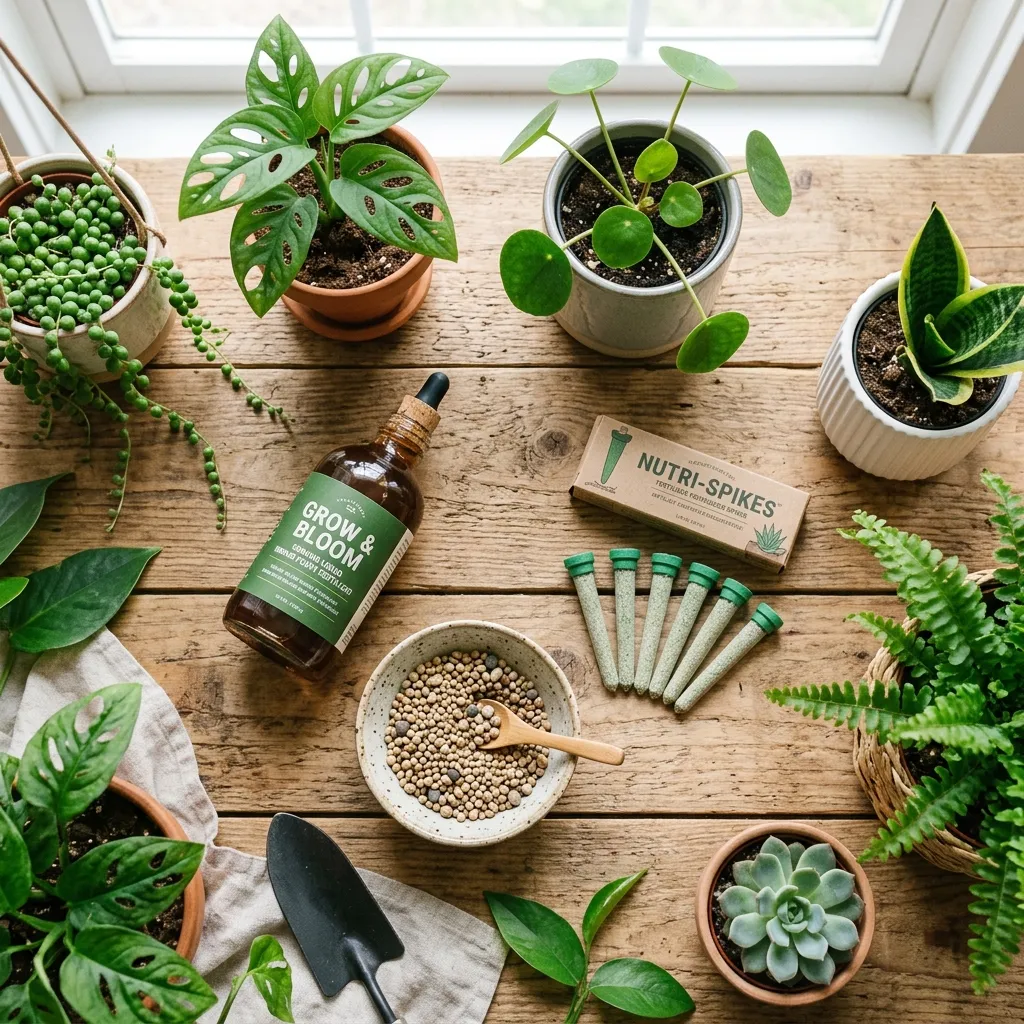
Introduction
Here’s something I wish someone had told me when I started growing houseplants: soil runs out of nutrients. It seems obvious now, but for my first year of plant parenthood, I assumed that watering and good light were all my plants needed. My Pothos was putting out smaller and smaller leaves. My peace lily hadn’t bloomed in over a year. Everything looked fine — just kind of… stalled.
Then I started fertilizing, and the difference was dramatic. Within a few weeks, my plants were pushing out bigger leaves, richer colors, and noticeably faster growth. It felt like I’d been accidentally starving them.
The challenge is that the fertilizer aisle (or Amazon search results) can be overwhelming. Liquid, granular, spikes, organic, synthetic, different NPK numbers — it’s a lot. In this guide, I’ll break down exactly what you need to know and share the specific products I’ve tested and trust. If you’re brand new to the topic, my beginner’s guide to indoor plant fertilizer covers the absolute basics.
NPK Ratios: What Those Three Numbers Mean
Every fertilizer label shows three numbers separated by dashes — something like 10-10-10 or 24-8-16. These represent the three primary macronutrients plants need:
- N (Nitrogen): Drives leaf and stem growth. This is the big one for foliage houseplants.
- P (Phosphorus): Supports root development and flowering. Important if you want blooms from your peace lily or African violet.
- K (Potassium): Helps overall plant health, disease resistance, and water regulation.
Which Ratio Should You Choose?
| Plant Type | Recommended NPK | Why |
|---|---|---|
| General foliage (Pothos, Monstera, Philodendron) | Balanced (10-10-10, 20-20-20) | Supports all-around growth |
| Flowering plants (Peace Lily, African Violet) | Higher P (10-30-20) | Promotes bloom production |
| Succulents and cacti | Lower N, balanced (2-7-7 or similar) | Prevents leggy, weak growth |
| Ferns | Higher N (30-10-10) | Supports lush frond production |
For most people with a mixed collection of common houseplants, a balanced liquid fertilizer is all you need. Don’t overthink this part.
The Three Types of Indoor Plant Fertilizer
Liquid Fertilizer
Liquid fertilizers are diluted in water and applied during regular watering. They’re the most popular choice for houseplants, and for good reason.
Pros:
- Immediate nutrient availability — plants can use them right away
- Easy to adjust concentration (just dilute more or less)
- Even distribution throughout the root zone
- Simple to stop if you notice signs of over-fertilizing
Cons:
- Requires consistent application every 2-4 weeks
- Easy to forget (or overdo it)
- You need to measure and mix each time
My top pick for liquid fertilizer:
Miracle-Gro Indoor Plant Food is the liquid fertilizer I reach for most often. It’s a balanced formula that works across my entire collection — from my Snake Plant to my Calathea. I dilute it to half the recommended strength (more on why below) and apply every two weeks during spring and summer.
🌿 Get Miracle-Gro Indoor Liquid Plant Food on AmazonThe pump bottle design makes measuring easy — no caps to fumble with, no spills. For a collection of 20-30 plants, one bottle lasts me an entire growing season.
Slow-Release Granular Fertilizer
Slow-release granules are mixed into the top layer of soil and gradually release nutrients over 2-6 months, depending on the product. They’re the “set it and forget it” option.
Pros:
- Apply once and you’re done for months
- Very low risk of fertilizer burn (nutrients release gradually)
- Ideal for forgetful plant parents
- Consistent, steady nutrition
Cons:
- Less control over nutrient concentration
- Can’t easily stop once applied
- Nutrients may release unevenly depending on watering patterns and temperature
- More expensive per application than liquid
My top pick for slow-release fertilizer:
Osmocote Smart-Release Plant Food is the gold standard for slow-release granular fertilizer. Each granule is coated with a resin that breaks down gradually based on temperature and moisture — warmer conditions release nutrients faster, which aligns perfectly with how plants grow more actively in warmth.
🌱 Get Osmocote Smart-Release Plant Food on AmazonI sprinkle Osmocote on top of the soil at the beginning of each growing season (late March or early April) and don’t think about it again until fall. It’s especially great for plants I tend to forget about, like my ZZ Plant on the back shelf.
Fertilizer Spikes
Spikes are compressed fertilizer in a solid stick form. You push them into the soil and they dissolve gradually over 1-2 months.
Pros:
- No measuring, no mixing — just push into soil
- Mess-free and travel-friendly
- Good for people who want the simplest possible routine
Cons:
- Nutrients concentrate around the spike rather than distributing evenly
- Can burn roots near the spike if planted too close to the stem
- Less cost-effective for large collections
- Limited control over dosage
My top pick for fertilizer spikes:
Miracle-Gro Indoor Plant Food Spikes are what I recommend if simplicity is your top priority. Push two spikes into opposite sides of a 6-inch pot (away from the stem), and you’re covered for about two months.
🪴 Get Miracle-Gro Indoor Plant Food Spikes on AmazonI’ll be honest — spikes aren’t my primary fertilizing method because I prefer the even distribution of liquid feeding. But I keep a box on hand for when life gets busy and I know I won’t stay on top of a liquid schedule.
Comparing Fertilizer Types at a Glance
| Feature | Liquid | Slow-Release Granular | Spikes |
|---|---|---|---|
| Ease of use | ⚠️ Requires mixing | ✅ Sprinkle and forget | ✅ Push into soil |
| Nutrient distribution | ✅ Even throughout soil | ✅ Fairly even | ❌ Concentrated near spike |
| Control over dosage | ✅ Highly adjustable | ⚠️ Limited | ❌ Fixed dose |
| Frequency | Every 2-4 weeks | Every 2-6 months | Every 1-2 months |
| Risk of burn | ⚠️ Moderate if over-applied | ✅ Low | ⚠️ Moderate near spike |
| Best for | Hands-on plant parents | Low-maintenance approach | Maximum simplicity |
| Cost per plant | 💲 Low | 💲💲 Medium | 💲💲 Medium |
Organic Fertilizer Options Worth Considering
If you prefer organic approaches, these are solid options I’ve experimented with. I don’t have specific product recommendations for each since formulations vary by region, but here’s what to look for:
Fish Emulsion
A classic organic liquid fertilizer made from — yes — processed fish. It’s high in nitrogen, which makes it excellent for leafy foliage plants. The downside is the smell. It’s not unbearable, but you will notice it for a day or two after application. I use fish emulsion outdoors more than indoors for this reason, but it works perfectly well for houseplants if the smell doesn’t bother you.
Worm Castings
Worm castings (vermicompost) are one of my favorite soil amendments. They’re gentle, nearly impossible to over-apply, and they improve soil structure while adding nutrients. I mix a handful into the soil when repotting houseplants, and I top-dress with a thin layer at the start of each growing season.
Worm castings won’t replace a dedicated fertilizer for heavy feeders, but they’re a wonderful supplemental nutrition source and soil conditioner.
Seaweed Extract
Seaweed-based fertilizers are low in NPK but rich in trace minerals, growth hormones, and beneficial compounds that support overall plant health. I think of seaweed extract as a vitamin supplement rather than a meal — it complements other fertilizers rather than replacing them. I add a splash to my watering can once a month during the growing season.
When to Fertilize (And When to Stop)
Timing matters more than most people realize. Here’s my seasonal approach:
Growing Season (March - September)
- Liquid: Every 2-4 weeks, diluted to half strength
- Granular: Apply once at the start of the season (March-April)
- Spikes: Insert fresh spikes every 2 months
Transition (October)
- Reduce liquid fertilizing to once a month at quarter strength
- No action needed for granular or spikes already in soil
Dormant Season (November - February)
- Stop fertilizing entirely. Most houseplants slow their growth dramatically in winter, and they can’t use the nutrients. Fertilizing during dormancy leads to salt buildup in the soil and potential root damage.
This schedule aligns with general watering guidelines for houseplants — plants that drink less in winter also eat less.
Signs Your Plants Need Fertilizer
Not sure if your plants are hungry? Look for these clues:
- Slow or stalled growth during the growing season
- Smaller new leaves compared to older leaves
- Pale or washed-out leaf color (especially in plants that should be deep green)
- Lower leaves yellowing and dropping while upper growth looks okay — check why leaves turn yellow to rule out other causes
- A plant that hasn’t been repotted in over a year has likely exhausted the nutrients in its soil
Signs of Over-Fertilizing (Fertilizer Burn)
More fertilizer is not better. Over-fertilizing is actually more harmful than under-fertilizing. Watch for:
- Brown, crispy leaf tips and edges — this is the classic sign
- White crusty buildup on the soil surface or around drainage holes
- Wilting despite moist soil — damaged roots can’t take up water
- Sudden leaf drop
- Root tips that appear brown or black when you check them
How to Fix Over-Fertilization
- Flush the soil: Run water through the pot for several minutes to wash away accumulated salts. Do this in a sink, bathtub, or outdoors.
- Remove visible salt crust from the soil surface.
- Skip fertilizing for at least 4-6 weeks.
- If damage is severe, consider repotting into fresh soil and using a quality soil mix.
My Fertilizing Routine (What I Actually Do)
After years of experimenting, here’s the system I’ve settled on for my collection of about 40 houseplants:
- Base nutrition: Miracle-Gro liquid at half strength, every two weeks, March through September.
- Slow-release backup: Osmocote granules on plants I tend to forget about or that live in hard-to-reach spots.
- Soil amendment: Worm castings mixed into fresh soil when repotting.
- Monthly supplement: A splash of seaweed extract in my watering can once a month.
- Winter: Nothing. I completely stop fertilizing from November through February.
This routine is simple enough that I actually stick to it, which is the whole point. The best fertilizing schedule is one you’ll actually follow.
Best Fertilizer for Beginners
If you’re just starting out and want one product to buy, go with the Miracle-Gro Indoor Liquid Plant Food. It’s affordable, available everywhere, works across virtually all common houseplants, and the pump dispenser makes it nearly foolproof.
Start at half the recommended strength. You can always add more, but you can’t un-fertilize a plant. This is the advice I give every beginner who asks, and it’s the same approach I recommend in the easiest indoor plants for beginners.
🌿 Start with Miracle-Gro Indoor Liquid Plant Food — Simple and EffectiveFAQs
Q: How often should I fertilize indoor plants? A: During the growing season (spring through early fall), most houseplants benefit from fertilizing every 2-4 weeks with liquid fertilizer, or every 2-3 months with slow-release granules. Stop fertilizing entirely during winter when most plants are dormant.
Q: Can you over-fertilize houseplants? A: Yes, and it’s more common than under-fertilizing. Signs include brown leaf tips, white salt crust on the soil surface, wilting despite moist soil, and yellowing leaves. If you suspect over-fertilization, flush the soil with plain water several times and skip fertilizing for at least a month.
Q: What NPK ratio is best for houseplants? A: A balanced ratio like 10-10-10 or 20-20-20 works well for most foliage houseplants. Flowering plants benefit from higher phosphorus (the middle number), such as 10-30-20. When in doubt, balanced is always a safe choice.
Q: Should I fertilize newly repotted plants? A: No. Wait at least 4-6 weeks after repotting before fertilizing. Fresh potting mix contains enough nutrients to sustain the plant initially, and the roots need time to recover from the stress of repotting before they can effectively absorb additional nutrients.
Q: Are organic fertilizers better than synthetic for houseplants? A: Neither is objectively better — they work differently. Organic fertilizers (fish emulsion, worm castings) release nutrients slowly and improve soil biology. Synthetic fertilizers provide nutrients immediately and are easier to dose precisely. Many plant parents, myself included, use a combination of both.
Q: Do I need different fertilizers for different plants? A: For most common houseplants, a single balanced fertilizer works fine. Specialty plants like orchids, succulents, or African violets can benefit from formulas tailored to their needs, but it’s not strictly necessary. I use the same all-purpose liquid fertilizer for 90% of my collection.
Happy feeding! 🌿