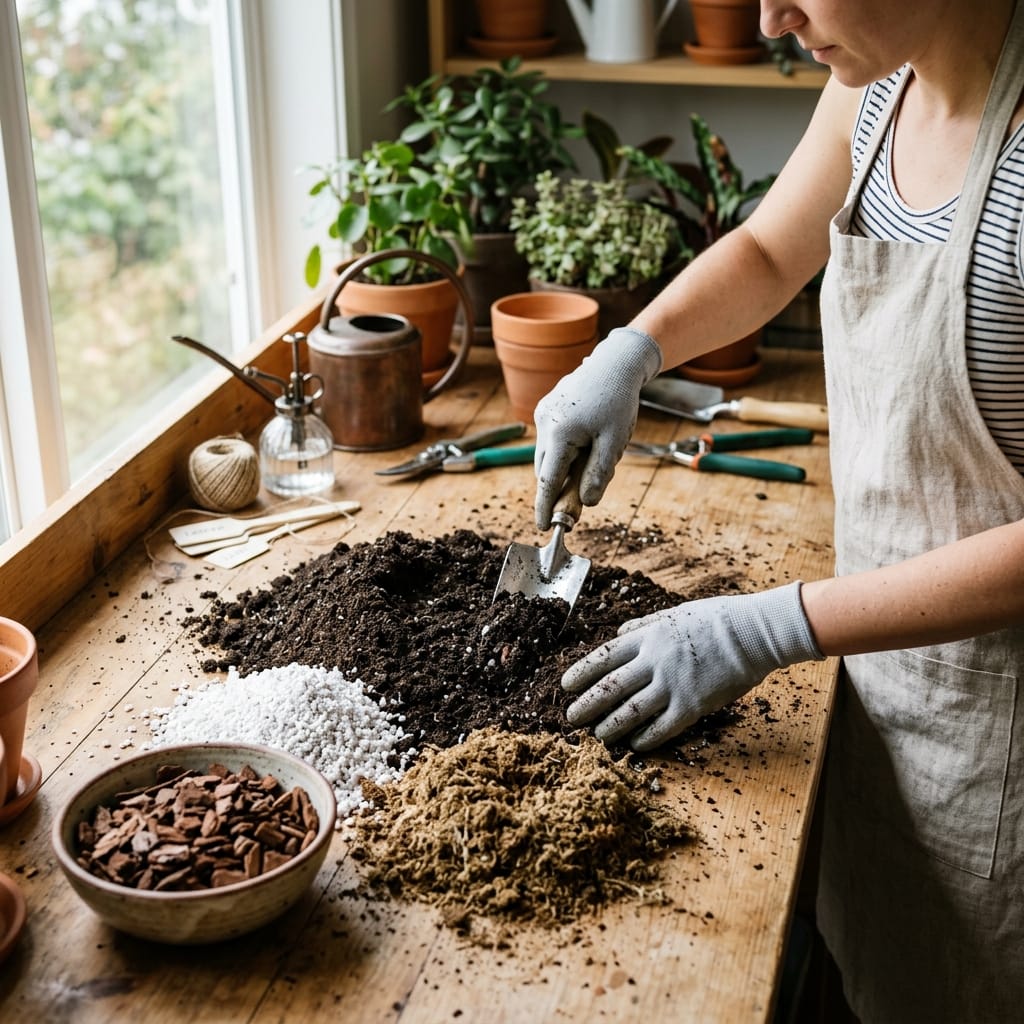
Here’s a truth that most beginner plant guides gloss over: the soil you use matters as much as how you water. You can nail your light and watering routine perfectly, but if your plant is sitting in dense, soggy soil, root rot is almost inevitable.
After killing more plants than I’d like to admit in my early years — almost always from soil-related issues — I started mixing my own soil. It changed everything. My plants grew faster, developed stronger root systems, and stopped dying from mysterious root rot.
This guide will teach you exactly what goes into good potting soil, and give you DIY recipes for every type of indoor plant.
Why Store-Bought Soil Often Falls Short
Most bags of “indoor potting soil” from hardware stores are:
- Too dense — retains too much water for most houseplants
- Too heavy — compacts over time, suffocating roots
- One-size-fits-all — a succulent and a fern have completely different needs
That’s not to say bagged soil is useless — it makes a great base. You just need to amend it for your specific plants.
The Key Soil Ingredients (and What They Do)
Understanding these core components lets you customize any mix:
| Ingredient | Purpose | Drainage | Moisture Retention |
|---|---|---|---|
| Potting soil | Base nutrition and structure | Low | High |
| Perlite | Air pockets, drainage | High | Low |
| Orchid bark | Chunky drainage, aeration | Very High | Low |
| Peat moss | Moisture retention, slight acidity | Low | Very High |
| Coco coir | Sustainable peat alternative | Medium | High |
| Vermiculite | Moisture retention, minerals | Low | Very High |
| Charcoal | Odor absorption, prevents bacteria | Medium | Low |
| Sand (coarse/horticultural) | Weight, drainage | High | None |
| Worm castings | Slow-release nutrients | Medium | Medium |
Where to Buy Ingredients
🌱 Get Premium Potting Mix on Amazon 🪨 Get Perlite on AmazonDIY Soil Mix Recipes
The Universal Houseplant Mix
Works for most tropical foliage plants — pothos, monstera, philodendron, peace lily, rubber plant.
| Ingredient | Ratio |
|---|---|
| Quality potting soil | 2 parts |
| Perlite | 1 part |
| Orchid bark (optional, recommended) | 1 part |
This mix drains well, holds adequate moisture, and gives roots plenty of air. It’s my default starting point for almost everything.
Aroid Mix (Monstera, Philodendron, Pothos)
Aroids have thick aerial roots that need lots of air circulation.
| Ingredient | Ratio |
|---|---|
| Potting soil | 1 part |
| Perlite | 1 part |
| Orchid bark | 1 part |
| Charcoal | Small handful |
Extra chunky for maximum drainage. Monsteras and pothos love this mix.
Succulent & Cactus Mix
Succulents need fast-draining soil that dries out quickly.
| Ingredient | Ratio |
|---|---|
| Potting soil | 1 part |
| Perlite | 1 part |
| Coarse sand | 1 part |
Or simply amend a store-bought cactus mix:
🌵 Get Cactus & Succulent Mix on AmazonTropical Fern Mix
Ferns need consistently moist (but not soggy) soil.
| Ingredient | Ratio |
|---|---|
| Potting soil | 2 parts |
| Peat moss or coco coir | 1 part |
| Perlite | 1 part |
This holds more moisture while still draining enough to prevent waterlogging.
Calathea & Prayer Plant Mix
Calatheas want moisture-retentive soil that still drains well — it’s a balancing act.
| Ingredient | Ratio |
|---|---|
| Potting soil | 2 parts |
| Perlite | 1 part |
| Coco coir | 1 part |
| Charcoal | Small handful |
Use filtered or distilled water with this mix — calatheas are sensitive to mineral buildup.
Snake Plant & ZZ Plant Mix
These drought-tolerant plants need very fast-draining soil.
| Ingredient | Ratio |
|---|---|
| Potting soil | 1 part |
| Perlite | 1 part |
| Coarse sand | 1 part |
This dries out fast, which is exactly what snake plants and ZZ plants want. You can also use straight cactus mix.
How to Mix Your Own Soil
What You Need
- A large bucket or bin
- Measuring container (any consistent scoop works — a cup, a small pot, whatever)
- The ingredients for your chosen recipe
- Gloves (optional but keeps hands clean)
Steps
- Measure ingredients into the bucket
- Mix thoroughly with your hands or a trowel
- Add water gradually until the mix is damp but not dripping — dry peat moss repels water initially
- Use immediately or store in a sealed container
Mix in batches — I usually make enough for 3-5 pots at a time.
Signs Your Soil Needs Changing
| Problem | What It Means | Solution |
|---|---|---|
| Water sits on top, won’t absorb | Soil is hydrophobic (dried out peat moss) | Soak pot in water to rehydrate, or repot |
| Water drains instantly, plant stays dry | Soil has broken down, lost structure | Repot with fresh mix |
| Soil stays wet for days | Too dense, poor drainage | Amend with perlite/bark or repot |
| White crust on soil surface | Mineral/fertilizer salt buildup | Flush with water or replace top inch |
| Compacted, hard soil | Organic matter decomposed | Repot with fresh, airy mix |
| Mushy roots when you check | Root rot from soggy soil | Rescue guide |
When it’s time, follow our step-by-step repotting guide.
The Sustainability Angle: Peat vs. Coco Coir
Traditional potting mixes use peat moss, which is harvested from ancient peat bogs. These ecosystems take thousands of years to form and are important carbon sinks. Coco coir is a byproduct of coconut processing and is renewable and sustainable.
For most houseplant applications, coco coir works just as well as peat moss. It:
- Has a more neutral pH (peat is acidic)
- Resists compaction better over time
- Rehydrates more easily when dry
- Is more environmentally responsible
I’ve switched most of my mixes to coco coir and haven’t noticed any performance difference.
Should You Sterilize Potting Soil?
If you’ve had problems with fungus gnats, sterilizing new soil before use can prevent them from entering your collection:
- Spread soil on a baking sheet
- Bake at 200°F (93°C) for 30 minutes
- Let cool completely before using
This kills gnat larvae, weed seeds, and pathogens. It smells earthy but not terrible.
Alternatively, microwave a damp batch for 2-3 minutes per quart.
Final Thoughts
Good soil is the foundation of good plant care. You don’t need to become a soil scientist — just understand that different plants need different drainage characteristics, and amend your base soil accordingly. Start with the Universal Houseplant Mix (2:1:1 soil:perlite:bark) and adjust from there.
Once you start mixing your own, you’ll wonder why you ever used straight bagged soil.
For more fundamentals, check out our beginner fertilizer guide and watering guide.