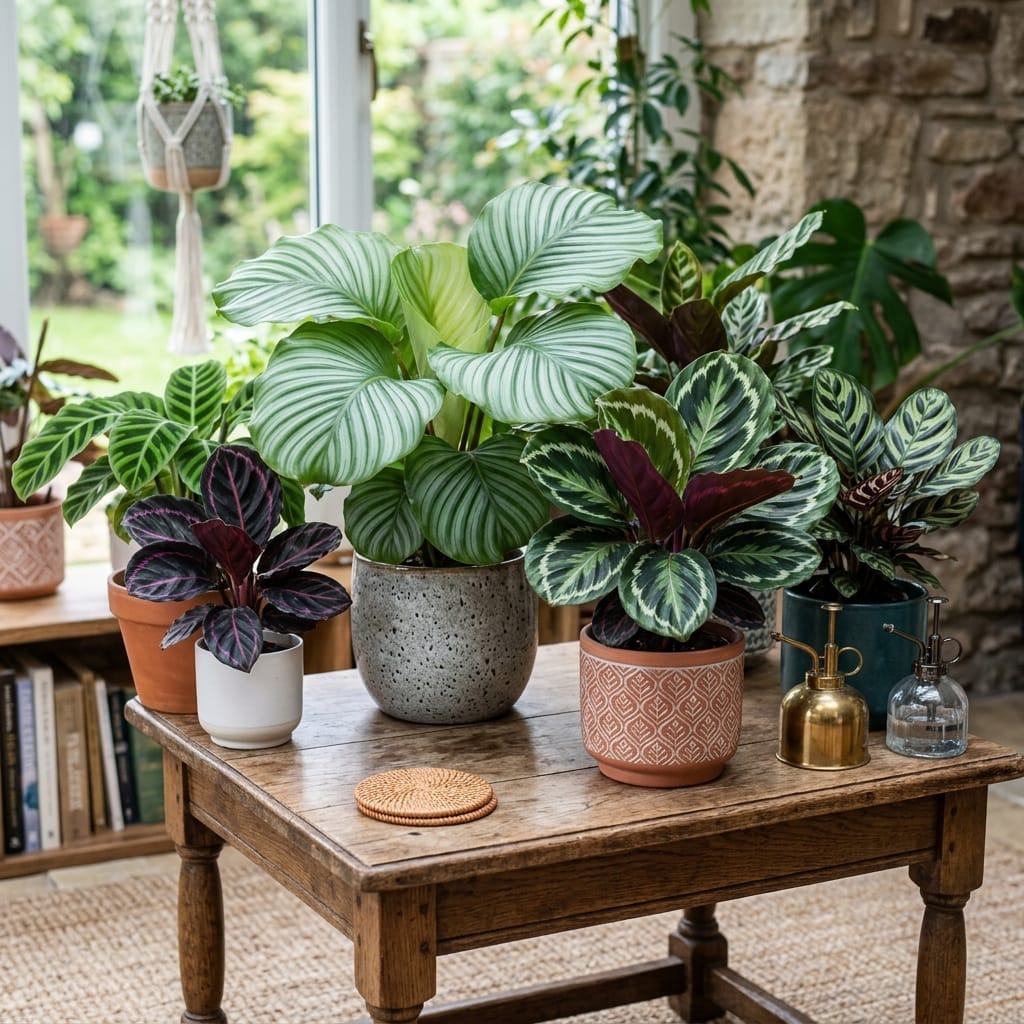
I’ll be honest: calatheas are the divas of the houseplant world. They have the most stunning foliage of any indoor plant — intricate patterns that look hand-painted, leaves that literally move throughout the day — but they will punish you with crispy brown edges the moment your humidity drops.
That said, once you crack the humidity code, they’re actually quite manageable. I killed my first two calatheas before figuring out that a $30 humidifier was all they needed. Now I have five thriving specimens and they’re some of my favorite plants.
Popular Calathea Varieties
Calathea orbifolia
Large, round leaves with silvery-green stripes. Probably the most elegant of all calatheas. Can grow quite large (2+ feet).
Calathea medallion
Classic variety with dark green tops, burgundy undersides, and a striking medallion pattern. The leaves curl up at night, showing off the purple undersides.
Calathea rattlesnake (Lancifolia)
Long, narrow, wavy-edged leaves with dark green spots on a lighter green background. Purple undersides. One of the easier calathea varieties.
Calathea white fusion
White, green, and lilac marbled leaves. Absolutely gorgeous but notoriously finicky — this is the “expert mode” calathea.
Calathea beauty star
Dark green leaves with bright pink stripes. One of the more tolerant varieties and a great starter calathea.
The #1 Rule: Humidity, Humidity, Humidity
Let me be blunt: if you can’t provide 50-60% humidity, don’t buy a calathea. Most homes sit at 30-40% in winter, which is far too low. Those crispy brown leaf edges that plague calathea owners? That’s dry air.
How to Provide Enough Humidity
- Humidifier (best solution): A small humidifier near your calathea collection is the single best investment. See our best humidifiers for plants review.
- Group plants together: Creates a natural humid microclimate.
- Pebble tray: A pebble tray beneath the pot provides localized humidity.
- Bathroom placement: If your bathroom gets indirect light, calatheas love the shower steam.
What doesn’t work: Misting. It raises humidity for about 15 minutes and can actually promote fungal issues on calathea’s broad leaves. Read more in our humidifier vs mister comparison.
For the full science, see do houseplants actually need humidity?
Light
Calatheas evolved on the jungle floor under a tree canopy, so they’re adapted to filtered, indirect light:
- Medium indirect light: The ideal. A north or east-facing window works perfectly.
- Low light: Most calatheas handle lower light well. They won’t grow as fast but won’t suffer.
- Bright indirect: Fine, but keep them away from direct sun.
- Direct sunlight: NEVER. It bleaches and burns the intricate leaf patterns. Even an hour of direct afternoon sun can cause permanent damage.
Watering
Calatheas are picky about water quality and consistency:
- Frequency: Keep soil consistently moist but never soggy. Water when the top inch dries — typically every 5-7 days.
- Water type: Use filtered, distilled, or rainwater. Calatheas are sensitive to fluoride and chlorine in tap water, which causes brown leaf tips. If you must use tap water, let it sit out overnight so chlorine evaporates.
- Temperature: Room temperature water only. Cold water shocks the roots.
Soil
- Well-draining but moisture-retentive (unlike snake plants which want fast drainage)
- Mix: 2 parts peat-based potting soil + 1 part perlite
- Keep slightly acidic (pH 6.0-6.5)
- Repot every 1-2 years in spring
Common Problems
| Problem | Cause | Fix |
|---|---|---|
| Brown, crispy leaf edges | Low humidity (the #1 issue) | Add humidifier, aim for 50-60% |
| Brown leaf tips | Fluoride/chlorine in water | Switch to filtered or distilled water |
| Curling leaves | Low humidity or underwatering | Increase humidity, check soil moisture |
| Fading leaf patterns | Too much direct light | Move to indirect light |
| Yellow leaves | Overwatering or cold drafts | Check drainage, move away from drafts |
| Drooping | Underwatering or root rot | Check soil — water if dry, inspect roots if wet |
| Leaves not moving | Stress from low light or dry air | Improve conditions, give it time |
Product Recommendations
1. Calathea Medallion
The classic starter calathea — gorgeous patterns and more forgiving than some varieties.
🌿 Get a Calathea Medallion2. LEVOIT Humidifier
The most effective way to keep calatheas happy. This model runs for days on a single fill.
💧 Get a HumidifierAre calatheas safe for pets? Yes! They’re one of the best pet-safe options with stunning foliage. See more in our pet-safe plants guide.
FAQs
Why do calathea leaves curl? Usually low humidity or underwatering. Increase humidity to 50-60% and check soil moisture. Nighttime curling is normal (prayer movement).
Are calatheas hard to care for? More demanding than pothos or snake plants, but manageable if you maintain 50-60% humidity.
Why do my calathea leaves have brown edges? Low humidity — the #1 calathea problem. Get a humidifier. Also check if you’re using unfiltered tap water.
Do calatheas need direct sunlight? No — direct sun bleaches and burns their leaves. Bright to medium indirect light is ideal.
Are calatheas safe for pets? Yes! Non-toxic to cats and dogs.
Why do calathea leaves move at night? It’s called nyctinasty — they raise leaves at night and lower them during the day. Completely normal and a sign of health.
Happy growing! 🌿