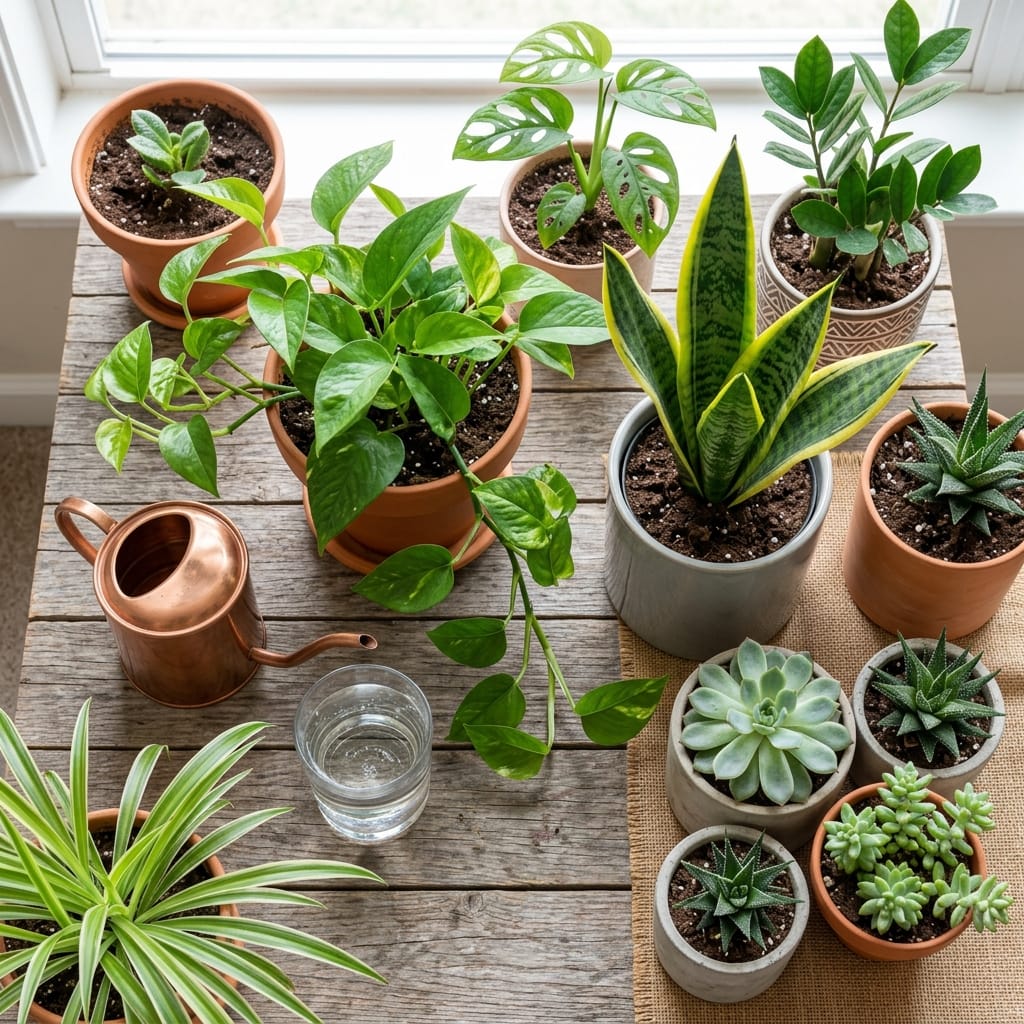
“How often should I water my plants?” is the number one question I get from new plant parents. And the honest answer is annoyingly unsatisfying: it depends.
But don’t worry — I’m not going to leave you with that. This guide will teach you how to actually read your plants and soil so you never have to guess again. Once you understand the principles, watering becomes intuitive rather than stressful.
The Golden Rule: Check the Soil, Not the Calendar
Rigid watering schedules (“every Sunday”) sound convenient, but they don’t account for reality. Your plant’s water needs change based on:
- Season (summer vs. winter)
- Temperature and humidity
- Pot size and material
- Soil type
- How much light it gets
- Whether it’s actively growing
The method that actually works: the finger test.
- Stick your finger 1-2 inches into the soil
- Dry? → Water thoroughly
- Moist? → Check again in a day or two
That’s it. This simple test is more accurate than any app, schedule, or gadget.
For an even more reliable reading, use a moisture meter:
📊 Get a Moisture Meter on AmazonHow to Water Properly
When you do water, do it right:
The Thorough Soak Method (Recommended)
- Water slowly and evenly across the soil surface
- Continue until water drains freely from the bottom drainage holes
- Let the pot drain for 10-15 minutes
- Empty the saucer — never let pots sit in standing water
This ensures the entire root ball gets moisture, not just the surface.
Bottom Watering (Great Alternative)
- Fill a basin or tray with 1-2 inches of water
- Set the pot in the water (must have drainage holes)
- Let it absorb for 15-30 minutes
- Remove and let drain
Benefits of bottom watering:
- Encourages deep root growth
- Keeps soil surface drier (reduces fungus gnats)
- More even moisture distribution
Do a top-water flush every 4-5 waterings to prevent mineral/salt buildup.
Watering Frequency by Plant Type
Here’s a realistic guide based on my experience. These assume average home conditions (65-75°F, 30-50% humidity):
Drought-Tolerant Plants (Water Every 2-4 Weeks)
| Plant | Water When… | Notes |
|---|---|---|
| Snake Plant | Soil is completely dry | Most overwatered plant |
| ZZ Plant | Soil is bone dry | Stores water in rhizomes |
| Succulents & Cacti | Soil is completely dry | Less is always more |
| Aloe Vera | Top 2 inches dry | Thick leaves store water |
Moderate Waterers (Every 7-14 Days)
| Plant | Water When… | Notes |
|---|---|---|
| Pothos | Top inch is dry | Very forgiving |
| Monstera | Top 2 inches are dry | Big leaves = big transpiration |
| Rubber Plant | Top 2 inches are dry | Slightly drought-tolerant |
| Fiddle Leaf Fig | Top 2 inches are dry | Consistent moisture is key |
| Spider Plant | Top inch is dry | Tuberous roots store water |
| Philodendrons | Top inch is dry | Similar to pothos |
Moisture Lovers (Every 5-10 Days)
| Plant | Water When… | Notes |
|---|---|---|
| Peace Lily | Top inch is dry | Droops dramatically when thirsty |
| Calathea | Soil is slightly moist | Never let fully dry out |
| Ferns | Soil stays consistently moist | Don’t let dry out |
| Alocasia | Top inch is dry | Likes consistent moisture |
Factors That Change Watering Frequency
Season
| Season | Effect on Watering |
|---|---|
| Spring/Summer | Water more — plants are actively growing, more evaporation |
| Fall/Winter | Water less — slower growth, cooler temps, less evaporation |
In winter, you might water some plants half as often as summer. This is the #1 reason fixed schedules fail — what works in July doesn’t work in January.
Pot Size and Material
| Pot Type | Drying Speed | Why |
|---|---|---|
| Terracotta | Fast | Porous — wicks moisture through walls |
| Ceramic (glazed) | Medium | Non-porous, retains more moisture |
| Plastic | Slow | Retains most moisture |
| Small pots | Fast | Less soil volume = dries quickly |
| Large pots | Slow | More soil holds more water |
Terracotta in summer? You might water twice a week. Same plant in a plastic pot in winter? Maybe every 3 weeks.
For more on pot selection, see our pot guide.
Light and Temperature
- More light = more photosynthesis = faster water consumption
- Higher temps = faster evaporation
- Plants near heating vents dry out faster
- Plants in dim corners need water much less often
Soil Type
- Dense, peat-heavy soil retains water longer
- Chunky, bark-heavy soil drains fast and dries quickly
- Added perlite increases drainage speed
Read our soil mixing guide to understand how your mix affects watering.
Warning Signs You’re Getting It Wrong
Overwatering Signs
| Symptom | What’s Happening |
|---|---|
| Yellowing leaves (especially lower) | Roots are drowning |
| Mushy, soft stems | Root rot progressing |
| Soil smells sour or funky | Anaerobic bacteria from soggy soil |
| Fungus gnats flying around soil | Moist surface breeding ground |
| Leaves dropping despite wet soil | Root rot — plant can’t absorb water |
If you suspect overwatering, see our overwatered plant rescue guide.
Underwatering Signs
| Symptom | What’s Happening |
|---|---|
| Wilting, drooping leaves | Cells losing turgor pressure |
| Dry, crispy leaf edges | Not enough moisture reaching extremities |
| Soil pulling away from pot edges | Severely dried out |
| Leaves curling inward | Conserving moisture |
| Slow or stunted growth | Not enough water for cellular processes |
Most underwatered plants recover fully within a few hours of a thorough watering.
Common Mistakes to Avoid
- Watering on a rigid schedule — Check soil instead
- Giving a little splash daily — Better to soak thoroughly, less often
- Watering at night — Morning is ideal (reduces fungal disease risk)
- Leaving water in saucers — Leads to root rot
- Using ice-cold water — Can shock tropical roots (use room temperature)
- Ignoring seasonal changes — Reduce watering significantly in winter
- Same schedule for every plant — Different plants have different needs
For the full breakdown, see our article on 7 watering mistakes beginners make.
Tools That Help
📊 Moisture Meter — takes the guessing out of watering 💧 Self-Watering Globes — great for vacations 🌱 Self-Watering Pot — ideal for forgetful waterersFinal Thoughts
Watering is the single most important plant care skill to master, and it’s really not complicated once you internalize one concept: check the soil before watering. That’s it. Forget schedules, forget apps, forget the advice that says “water every Thursday.” Your finger is the best tool you have.
Start with the finger test, learn what your specific plants need, and adjust for the seasons. You’ll develop an intuition for it faster than you think.
New to plant parenting? Start with our beginner’s guide.