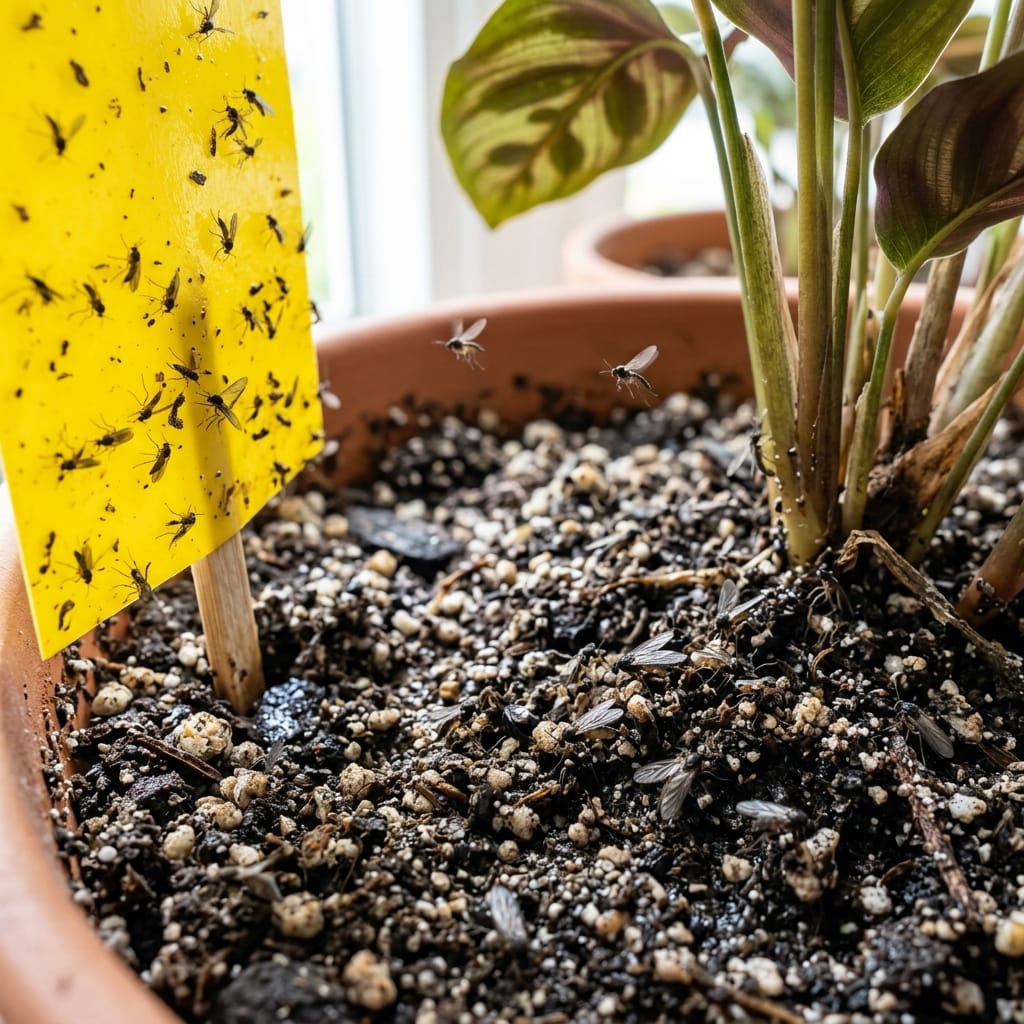
You know the feeling: you’re watering your beloved plants when you notice tiny black flies buzzing around the soil. You swat a few away, but the next day there are more. And more. And more.
Fungus gnats. They’re the most common houseplant pest, and they’re infuriatingly persistent if you don’t address the root cause (pun intended). The good news? They’re totally beatable with the right strategy.
I’ve dealt with at least four serious infestations over the years. Here’s the battle-tested plan that works every time.
What Are Fungus Gnats?
Fungus gnats (Bradysia spp.) are small dark flies about 1/8 inch long that hover around houseplant soil. They look like tiny mosquitoes and are weak, erratic fliers — you’ll see them lazily drifting near the soil surface or flying toward windows.
The lifecycle:
- Adults lay eggs in moist soil (up to 200 per female!)
- Eggs hatch into tiny white larvae in 4-6 days
- Larvae feed on organic matter and fungus in the soil for 2 weeks
- Larvae pupate, then emerge as adults
- Adults live about 7-10 days, reproduce, and die
The entire lifecycle is about 3-4 weeks. To beat them, you need to break this cycle by attacking both adults AND larvae simultaneously.
The 3-Step Eradication Plan
Step 1: Catch the Adults (Immediate)
Yellow sticky traps are your first line of defense. Fungus gnats are strongly attracted to yellow and will fly right into the sticky surface.
🪤 Get Yellow Sticky Traps on Amazon- Place traps directly on the soil surface or stick them into the soil on small stakes
- Put one in every infested pot
- Replace when full
- This won’t solve the problem alone, but it immediately reduces the breeding population
Why this matters: Every adult you catch is up to 200 fewer eggs being laid.
Step 2: Kill the Larvae (The Real Fix)
Adults are the visible symptom, but larvae in the soil are the real problem. You need to kill them where they live.
Option A: Hydrogen Peroxide Drench (Easiest)
Mix 1 part 3% hydrogen peroxide with 4 parts water. Water your plants normally with this solution.
- The peroxide kills larvae on contact
- The soil will fizz and bubble — totally normal
- Safe for plant roots
- Repeat with your next 2-3 waterings
Option B: Mosquito Bits / BTI (Most Effective)
Mosquito Bits contain Bacillus thuringiensis israelensis (BTI) — a naturally occurring bacterium that’s toxic to gnat and mosquito larvae but completely safe for plants, pets, and people.
🦟 Get Mosquito Bits on AmazonHow to use:
- Soak 2-4 tablespoons of Mosquito Bits in 1 gallon of water for 30 minutes
- Strain out the bits
- Water your plants with the BTI-infused water
- Repeat weekly for 3-4 weeks
This is my #1 recommendation — it’s biological, safe, and extremely effective.
Option C: Neem Oil Soil Drench
Mix neem oil according to package directions and use it as a soil drench. It disrupts the larvae’s ability to feed and grow.
- Also prevents other common houseplant pests
- Takes longer to work than hydrogen peroxide or BTI
- Use as a supplement, not primary treatment
Step 3: Prevent Re-infestation (Long-Term)
Once you’ve broken the cycle, prevent them from coming back:
Let Soil Dry Between Waterings
This is the most important prevention step. Fungus gnat larvae need moist soil to survive. If the top 1-2 inches of soil dries out between waterings, larvae can’t develop.
This doesn’t mean neglecting your plants — it means watering properly. Check out our watering guide for specifics.
Add a Soil Barrier
Cover the soil surface with a 1/2 inch layer of:
- Coarse sand — larvae can’t penetrate it
- Perlite — dries quickly, inhospitable to eggs
- Diatomaceous earth — microscopically sharp particles kill larvae (reapply after watering)
Screen Your Drainage Holes
Gnats can enter pots through drainage holes. Place a small piece of landscape fabric or mesh screen over drainage holes to block entry while allowing water to flow.
Prevention Checklist
Here’s how to stop fungus gnats before they start:
- Don’t overwater — let the top inch of soil dry between waterings
- Use well-draining soil — add perlite to retain less moisture
- Inspect new plants — quarantine for 2 weeks before adding to your collection
- Bake new potting soil — spread on a baking sheet at 200°F for 30 minutes to sterilize (sounds extreme, works great)
- Keep a sticky trap in problem-prone plants as an early warning system
- Bottom-water when possible — keeps the soil surface drier
Common Questions About Treatment
“Will letting the soil dry completely kill them?”
Drying out the soil helps but won’t fully eliminate an infestation on its own. Larvae are surprisingly resilient and can survive in partially dry soil. Use this strategy in combination with sticky traps and a soil treatment.
“Can I repot to get rid of them?”
You can, but it’s usually overkill. If you do repot:
- Shake off as much old soil as possible
- Use fresh, sterile potting mix
- Add perlite for better drainage
- Still treat with BTI water as a precaution
See our repotting guide for the proper technique.
“Do those apple cider vinegar traps work?”
Somewhat. A small dish of apple cider vinegar with a drop of dish soap can catch adults, but yellow sticky traps are significantly more effective. ACV traps can supplement your strategy but shouldn’t be your only approach.
Timeline: What to Expect
| Timeframe | What You’ll See |
|---|---|
| Day 1-3 | Sticky traps start catching adults |
| Day 3-7 | Fewer adult gnats visible after first soil treatment |
| Week 2 | Dramatic reduction — most visible gnats are gone |
| Week 3-4 | Any remaining eggs have hatched and been killed by ongoing treatment |
| Week 4+ | Should be gnat-free. Remove traps after a full week with no new catches |
When to Worry (and When Not To)
Don’t panic if you see a few gnats — a small population is annoying but not dangerous to established plants.
Take action if you see:
- Clouds of gnats rising when you water
- Gnats in every room of your house
- Seedlings wilting despite proper watering (larvae damage)
For other common pest issues, check out our complete indoor plant pest guide.
Final Thoughts
Fungus gnats are annoying but they’re a completely solvable problem. The key is attacking both adults (sticky traps) and larvae (BTI or hydrogen peroxide) simultaneously, then preventing re-infestation by adjusting your watering habits. Consistency is everything — keep treating for 3-4 weeks to break the full lifecycle.
You’ve got this.