Introduction
If you’ve ever tried to grow houseplants in a room without great natural light, you know the struggle. Leggy growth, pale leaves, variegation fading — the signs of a light-starved plant are unmistakable. A grow light solves all of this, but the moment you start shopping, you hit the big question: LED or fluorescent?
I spent an embarrassing amount of time researching this a few years ago when I moved into an apartment with north-facing windows. My snake plants were fine, but everything else was visibly unhappy. I started with a cheap T5 fluorescent shop light — it worked, but it ran warm, drove up my electric bill, and I burned through bulbs faster than expected. A year later I switched most of my setup to LEDs, and I haven’t looked back.
That said, fluorescents aren’t bad lights — they’re proven technology that has helped people grow plants indoors for decades. The question isn’t whether they work, but whether LEDs work better for your specific situation and budget. In this guide, I’ll break down the real-world differences so you can make a smart decision without wading through pages of conflicting opinions online.
Quick Comparison Table
| Feature | LED Grow Lights | Fluorescent Grow Lights |
|---|---|---|
| Energy Efficiency | ⭐⭐⭐ Excellent | ⭐⭐ Moderate |
| Heat Output | Low | Moderate |
| Lifespan | 50,000+ hours | 10,000-20,000 hours |
| Upfront Cost | $20-80+ | $15-40 |
| Running Cost | Low ($1-2/month typical) | Higher ($3-5/month typical) |
| Spectrum Options | Full spectrum, tunable | Full spectrum (limited tuning) |
| Light Intensity (PAR) | High per watt | Moderate per watt |
| Placement Distance | 12-24 inches from plants | 6-12 inches from plants |
| Bulb Replacement | Rarely needed | Every 1-2 years |
| Best For | Most indoor plant setups | Budget setups, seed starting |
Understanding What Plants Actually Need From Light
Before diving into the LED vs fluorescent debate, it helps to understand what plants are actually looking for when it comes to light. This isn’t as complicated as some sources make it seem.
PAR: The Light That Matters
Plants don’t care about lumens — that’s a measurement of how bright light appears to human eyes. What plants care about is PAR (Photosynthetically Active Radiation), which measures light in the 400-700 nanometer wavelength range that drives photosynthesis. When comparing grow lights, PAR output is the number that actually matters.
Both LED and fluorescent lights can deliver PAR, but LEDs are significantly more efficient at converting electricity into PAR. This means a 20-watt LED can often deliver the same usable light to your plants as a 40-watt fluorescent tube.
The Spectrum Question
Plants primarily use red light (~630-660nm) and blue light (~430-460nm) for photosynthesis:
- Blue light promotes compact, leafy growth and strong stems
- Red light encourages flowering, fruiting, and overall energy production
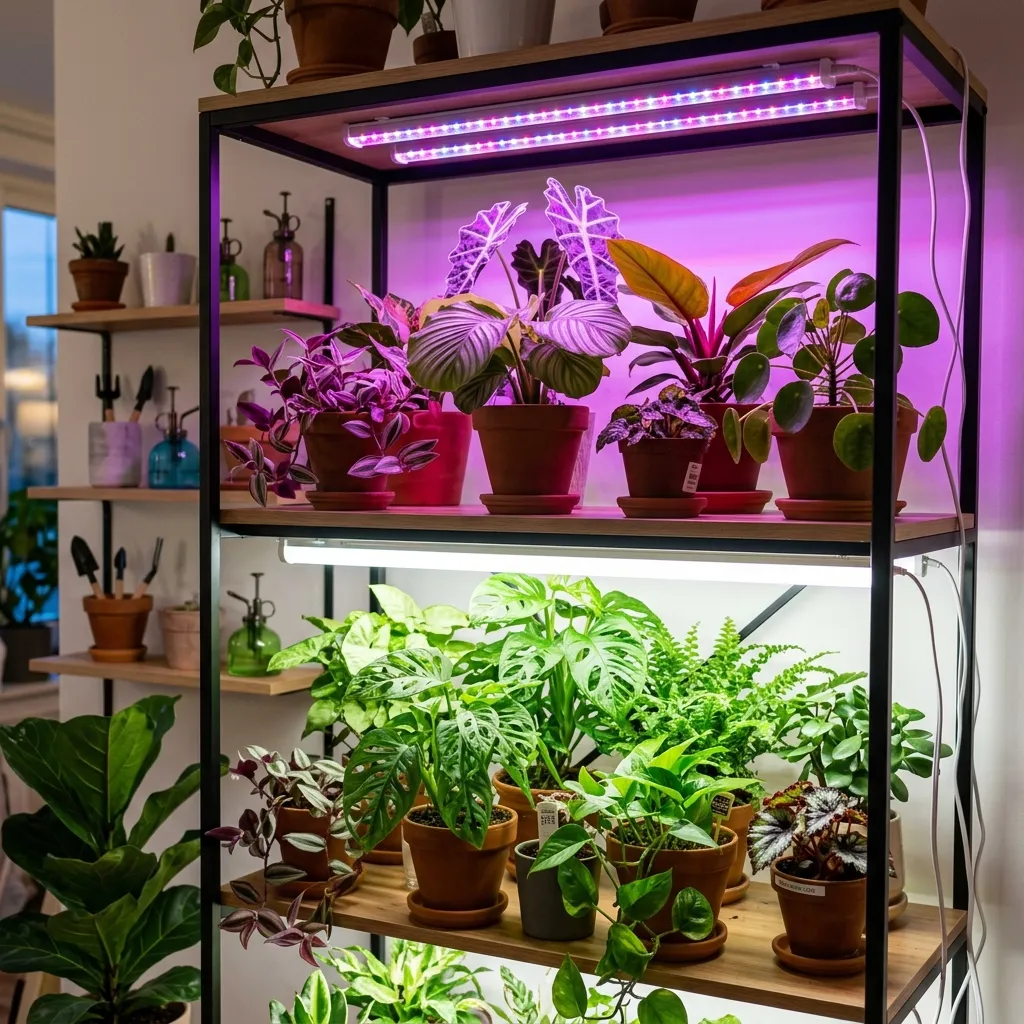
Modern full-spectrum grow lights — both LED and fluorescent — provide a blend of these wavelengths along with green and other colors. The old-school purple/blurple LED panels that only output red and blue light still exist, but most quality LEDs now produce a white, natural-looking light that’s much more pleasant to live with.
For a deeper exploration of how to actually set up and use grow lights, check out my guide on how to use grow lights for indoor plants.
LED Grow Lights: The Modern Standard
LED (Light Emitting Diode) technology has improved dramatically over the past decade, and LEDs have become the go-to choice for most indoor gardeners. Here’s why.
Advantages of LED Grow Lights
Energy efficiency is the single biggest advantage. LEDs convert a much higher percentage of electricity into usable light for plants, wasting far less energy as heat. In my setup, switching from a 4-foot T5 fluorescent fixture to an equivalent LED panel cut my electricity usage for that shelf by roughly 40-50%.
Low heat output means you can place LEDs closer to your plants without worrying about leaf burn, and your room doesn’t heat up. This matters more than you’d think — I used to run my fluorescent shelf lights during the day and my air conditioner would kick in more frequently as a direct result.
Lifespan is exceptional. A quality LED grow light is rated for 50,000+ hours, which translates to roughly 11 years at 12 hours per day. I’ve been using my main LED panels for over three years with zero degradation in performance that I can see. With fluorescents, I was replacing tubes every 12-18 months because their output gradually diminishes.
Spectrum customization is another win. Many LED grow lights offer full-spectrum white light that looks natural in your living space — no more bathing your apartment in an eerie purple glow. Some higher-end models let you toggle between spectrum modes or adjust intensity with dimmers.
Disadvantages of LED Grow Lights
Higher upfront cost is the main drawback. A decent LED grow light panel or strip costs $25-60, while equivalent fluorescent fixtures can be found for $15-30. The cost gap has narrowed significantly in recent years, though, and when you factor in electricity savings and bulb replacement costs, LEDs pay for themselves within a year or two.
Quality varies wildly. The LED grow light market is flooded with cheap products making exaggerated claims about wattage and coverage. A light that says “1000W” on the box often draws only 100-150 actual watts. Stick with established brands and check actual wattage draw and PAR measurements in reviews.
My Favorite LED Grow Lights
After testing several options, here are the LED lights I actually use and recommend:
🌿 GE Balanced Spectrum LED Grow Light — My Go-To for Individual PlantsThe GE grow light bulb is perfect if you just need to supplement light for one or two plants. It screws into a standard lamp socket and produces a pleasant, natural-looking light. I use one in a desk lamp next to my pothos in my home office.
🌿 Clip-On LED Grow Light — Great for Small Spaces and DesksClip-on gooseneck lights are fantastic for targeting light at a specific plant. They’re affordable, adjustable, and don’t take up shelf space. I have one clipped to my bedroom nightstand shelf, angled at a small Raven ZZ.
🌿 Relassy Panel Grow Light — Serious Coverage for Plant ShelvesIf you’re lighting a full shelf of plants, a panel light gives you even, broad coverage. I upgraded to a panel setup for my main plant shelf and the difference in growth was noticeable within a month.
For a broader roundup of options, my best grow lights for houseplants guide covers everything from budget to premium.
Fluorescent Grow Lights: The Proven Veteran
Fluorescent lights have been the standard for indoor growing since long before LEDs hit the consumer market. They still work — and for certain use cases, they remain a solid option.
Types of Fluorescent Grow Lights
T5 High Output (T5 HO) fluorescent tubes are the most common type used for plants. They’re slim, relatively efficient for fluorescent technology, and widely available. A 4-foot T5 HO fixture with 2-4 tubes can effectively light a multi-plant shelf setup.
CFL (Compact Fluorescent) grow lights screw into standard sockets and work well for supplementing individual plants, similar to LED bulbs. They’re inexpensive but produce more heat and use more electricity than LED equivalents.
T8 fluorescent tubes are the older, thicker tubes you see in shop lights and office ceilings. They work for growing plants but are less efficient than T5 HO and are gradually being phased out.
Advantages of Fluorescent Grow Lights
Lower upfront cost is the primary advantage. A basic T5 HO fixture can be found for $15-25, and replacement tubes are $5-10 each. If you’re on a tight budget and want to start growing under lights immediately, fluorescents are the cheapest way in.
Proven track record. Indoor growers, seed starters, and hobbyists have been using fluorescent lights successfully for decades. There’s a massive body of knowledge about what works, and you can trust that a decent T5 HO fixture will deliver adequate light for most houseplants.
Even light distribution. Fluorescent tubes naturally spread light evenly along their length, which is beneficial for shelf setups with multiple plants. You don’t get the hotspots that some poorly designed LED panels produce.
Disadvantages of Fluorescent Grow Lights
Higher electricity costs add up over time. Fluorescent lights waste more energy as heat, meaning more of your electricity bill goes toward warming your room rather than feeding your plants.
Shorter lifespan and degradation. Fluorescent tubes typically last 10,000-20,000 hours, but their light output degrades steadily from day one. By the time a tube reaches half its rated lifespan, it may be delivering 20-30% less PAR than when it was new. I recommend replacing tubes every 12-18 months if you’re relying on them as a primary light source.
More heat output. While fluorescents don’t get as hot as old incandescent or HID lights, they do generate noticeably more heat than LEDs. In a small room or closed shelf unit, this can raise the ambient temperature and potentially stress heat-sensitive plants.
Mercury content. Fluorescent tubes contain a small amount of mercury, which means they require special disposal — you can’t just toss them in the trash. Most hardware stores and recycling centers accept used fluorescent tubes, but it’s an extra step.
🌿 Barrina T5 Grow Light Strips — Affordable Option for Shelf SetupsRunning Cost Comparison
Let’s get specific about the cost difference, because this is where the LED advantage really shows.
Example: Lighting a 4-Foot Plant Shelf, 12 Hours/Day
| Cost Factor | LED Panel (~40W actual) | T5 HO Fluorescent (~54W per tube, 2 tubes = 108W) |
|---|---|---|
| Monthly electricity | ~$1.50 | ~$4.00 |
| Annual electricity | ~$18 | ~$48 |
| Bulb replacement (annual) | $0 | ~$15 (2 tubes) |
| Total annual operating cost | ~$18 | ~$63 |
| 5-year operating cost | ~$90 | ~$315 |
Assumes $0.13/kWh national average electricity rate.
Even accounting for a higher upfront cost for the LED panel ($40-60 vs. $20-30 for a fluorescent fixture), the LED pays for itself within the first year through electricity savings alone. Over five years, the difference is significant.
Heat Output: Why It Matters More Than You Think
Heat from grow lights affects your plants and your living space in ways that aren’t always obvious:
- Plant stress: Excessive heat from a light positioned too close can cause leaf curling, browning, or accelerated soil drying. With fluorescents, I had to water my plants under the lights more frequently because the heat was drying out the soil faster.
- Room temperature: In a small apartment or a room with multiple light fixtures, fluorescent heat output can noticeably raise the ambient temperature. This isn’t necessarily bad in winter, but in summer it can make your space uncomfortable and increase cooling costs.
- Placement flexibility: Because LEDs run cooler, you can position them closer to your plants if needed, or mount them in enclosed shelf units without worrying about heat buildup. Fluorescents need more breathing room.
Best Use Cases: Matching Light to Purpose
LED Is the Best Choice When:
- You’re lighting a permanent plant shelf or display — energy efficiency and longevity matter most for long-term setups
- You live in a warm climate — less heat from your lights means less work for your air conditioner
- You want a natural-looking light — full-spectrum white LEDs look like daylight, not like a laboratory
- You have light-hungry plants — LEDs deliver more PAR per watt, critical for plants that need bright light
- You want minimal maintenance — no tube replacements for a decade or more
Fluorescent Is Still a Good Choice When:
- You’re on a tight budget — fluorescent fixtures are genuinely cheaper upfront
- You’re starting seeds or growing herbs temporarily — seasonal setups don’t need long-term efficiency
- You already own a fluorescent fixture — no point replacing it until it dies; just swap in fresh tubes
- You’re lighting a large, open area — T5 tubes distribute light evenly across wide surfaces
My Recommendation
If you’re buying new, go LED. The technology has matured to the point where the upfront cost difference is minimal, and the long-term savings in electricity and bulb replacements make it a clear winner. I’ve gradually transitioned my entire indoor garden to LEDs, and the combination of lower heat, better efficiency, and no maintenance has been worth the switch.
If you already have a functioning fluorescent setup and your plants are healthy, there’s no urgency to replace it. Keep using what works and plan to transition when your tubes need replacing.
For a more detailed guide on choosing specific products, check out my guide to choosing the best grow lights for houseplants and my updated best grow lights for houseplants product roundup.
If you’re in a low-light apartment and wondering whether a grow light is even necessary, my post on the top 5 indoor plants for low-light apartments covers which plants can get by without supplemental lighting, and which ones really benefit from it. And for anyone setting up grow lights in a home office, my guide to the best indoor plants for offices includes lighting recommendations alongside plant picks.
FAQs
Q: Are LED grow lights better than fluorescent for houseplants? A: For most indoor plant owners, yes. LED grow lights use less electricity, produce less heat, last 3-5x longer, and are available in optimized spectrums for plant growth. Fluorescent lights still work well but are less efficient and need replacing more often.
Q: Can I use regular LED bulbs as grow lights? A: Regular LED bulbs provide some light that plants can use, but they aren’t optimized for photosynthesis. Dedicated grow light LEDs are tuned to deliver the red and blue wavelengths plants need most. For low-light tolerant plants, a bright regular LED nearby can supplement natural light, but it won’t replace a proper grow light for light-hungry plants.
Q: How close should LED and fluorescent grow lights be to plants? A: Fluorescent lights should be positioned 6-12 inches from plant foliage because their light intensity drops off quickly with distance. LED grow lights can typically be placed 12-24 inches away, depending on wattage, because they deliver more concentrated light output.
Q: Do fluorescent grow lights use a lot of electricity? A: Fluorescent lights use roughly 2-3x more electricity than LEDs to produce the same amount of usable plant light (PAR). A typical T5 fluorescent fixture running 12 hours daily might cost $3-5 per month, while an equivalent LED might cost $1-2 per month.
Q: How long do LED grow lights last compared to fluorescent? A: LED grow lights typically last 50,000+ hours, which is roughly 10-15 years at 12 hours of daily use. Fluorescent bulbs last 10,000-20,000 hours, or about 2-5 years at the same usage. LEDs also don’t degrade in output as quickly as fluorescents do over time.
Q: Are fluorescent grow lights still worth buying? A: Fluorescent T5 fixtures are still a solid, proven option — especially if you find a good deal or already own a fixture. They work well for seedlings, herbs, and low-to-medium light houseplants. However, for new purchases, LED is usually the better long-term investment.
Happy growing! 🌿