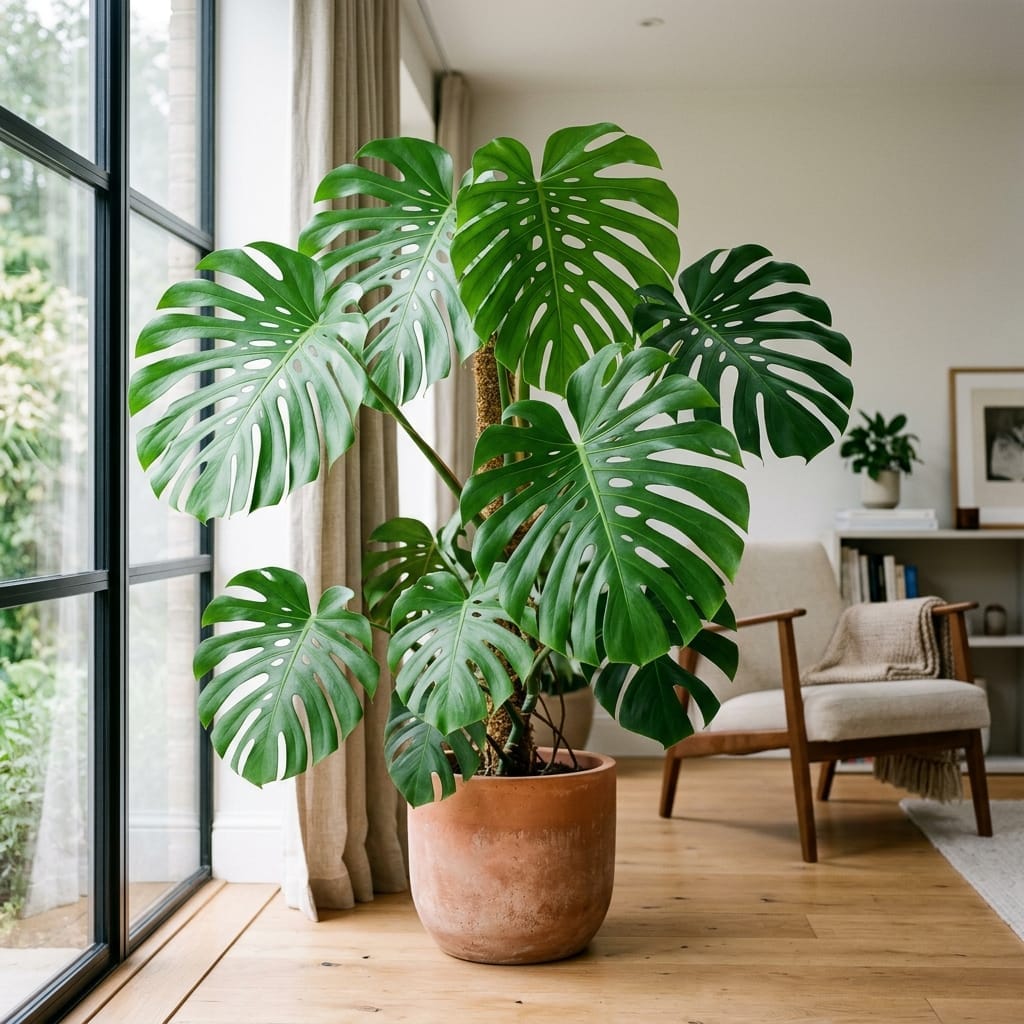
The monstera deliciosa — the “swiss cheese plant” — has become the unofficial mascot of the houseplant world. Those dramatic split leaves show up on everything from throw pillows to tattoos, and for good reason: it’s a genuinely beautiful plant that’s surprisingly easy to grow indoors.
I got my first monstera as a small, four-leaf plant and it’s now a beast pushing against my ceiling. That transformation happened in about two years with nothing more than a good window, a moss pole, and regular watering. If you give a monstera what it wants, it’ll reward you with impressive growth.
Light
Light is the single most important factor for monstera growth and leaf development:
- Bright indirect light: The sweet spot. Place near an east or north window, or a few feet from a south/west window. This is where you’ll get the biggest leaves and best fenestrations.
- Medium light: Acceptable. Growth will be slower and leaves smaller, but the plant stays healthy.
- Low light: Survives but struggles. Leggy growth, small leaves, no splits. Not recommended.
- Direct sun: 1-2 hours of gentle morning sun is fine. Avoid harsh afternoon sun — it burns the leaves.
The fenestration connection: Monsteras develop their iconic splits and holes in response to bright light. A monstera in a dark corner will produce solid, small leaves. The same plant in a bright spot will produce the dramatic split leaves everyone wants. Read our dedicated guide on why your monstera isn’t splitting.
Watering
- Frequency: Every 1-2 weeks. Let the top 2 inches of soil dry between waterings.
- Method: Water thoroughly until it drains from the bottom. Empty the saucer.
- Winter: Reduce to every 2-3 weeks as growth slows.
- Signs of overwatering: Yellow leaves, mushy stems, fungus gnats in soil.
- Signs of underwatering: Curling leaves, drooping, brown crispy edges.
Pro tip: Monsteras communicate clearly. If the leaves are curling inward, it needs water. If lower leaves are yellowing, you’re watering too much.
Humidity
Monsteras are tropical plants and appreciate humidity above 40%:
- 40-60%: Good — most homes hit this in summer.
- Below 30%: You’ll see brown leaf edges, especially in winter.
- Solutions: Group plants together, use a humidifier, or try a pebble tray.
For the full science on plant humidity needs, read do houseplants need humidity?
Soil and Repotting
- Soil: Well-draining aroid mix. Combine regular potting soil with perlite and orchid bark (2:1:1 ratio) for the chunky, airy texture monsteras love.
- Repotting: Every 1-2 years. Monsteras grow fast and will become rootbound quickly. Go up 2 inches in pot diameter.
- Drainage: Non-negotiable. Always use a pot with drainage holes.
Learn more in our repotting guide.
The Moss Pole: Your Secret Weapon
In the wild, monsteras are climbing plants that grow up trees. Indoors, a moss pole mimics this:
- Bigger leaves: Climbing monsteras produce significantly larger leaves with more fenestrations.
- Structural support: Without support, the heavy stems flop over and the plant sprawls.
- How to use: Insert a moss pole into the pot and tie the main stem loosely with soft plant ties. Mist the pole occasionally — aerial roots will attach over time.
Propagation
Monstera propagation is straightforward:
- Identify a node — the bump on the stem where leaves and aerial roots emerge
- Cut below the node with clean shears, including one leaf and any aerial roots
- Root in water: Place the node end in water. Change weekly. Roots appear in 4-6 weeks.
- Root in moss: Alternatively, wrap the node in moist sphagnum moss. This produces stronger roots.
- Plant once roots are 3+ inches long. Use aroid mix.
Important: Each cutting MUST have a node. A leaf without a node will never root — it’s a common mistake.
Common Problems
| Problem | Cause | Fix |
|---|---|---|
| Yellow lower leaves | Overwatering or natural aging | Check soil moisture, reduce watering |
| Brown crispy edges | Low humidity or underwatering | Increase humidity, water more consistently |
| No fenestrations | Immature plant, low light, no support | Brighter light, add moss pole, patience |
| Leggy, stretched growth | Insufficient light | Move to brighter location |
| Brown spots with yellow halo | Bacterial leaf spot | Remove affected leaves, improve air circulation |
| Drooping | Needs water or root rot | Check soil — water if dry, inspect roots if wet |
| Aerial roots everywhere | Normal! | Guide into soil or moss pole; don’t cut them |
Product Recommendations
1. Monstera Deliciosa Plant
A healthy, established monstera shipped to your door. Look for one with at least 3-4 leaves for a head start.
🌿 Get a Monstera on Amazon2. Moss Pole for Climbing
Essential for encouraging bigger leaves and fenestrations. Coco coir poles are durable and easy to use.
🌱 Get a Moss Pole3. Aroid Potting Mix
Pre-mixed chunky soil designed for monsteras, philodendrons, and other aroids. Excellent drainage and aeration.
🪴 Get Aroid Soil MixFAQs
Why doesn’t my monstera have holes? Monsteras develop fenestrations as they mature (2-3 years). Bright indirect light and a moss pole accelerate this. See our fenestration guide.
How often should I water? Every 1-2 weeks when the top 2 inches are dry. Less in winter.
Can monstera grow in low light? They’ll survive but won’t thrive — slow growth, small leaves, no splits.
Are monsteras toxic to pets? Yes. See our pet-safe alternatives.
How do I propagate a monstera? Cut below a node, root in water (4-6 weeks) or sphagnum moss. Each cutting needs at least one node.
Happy growing! 🌿