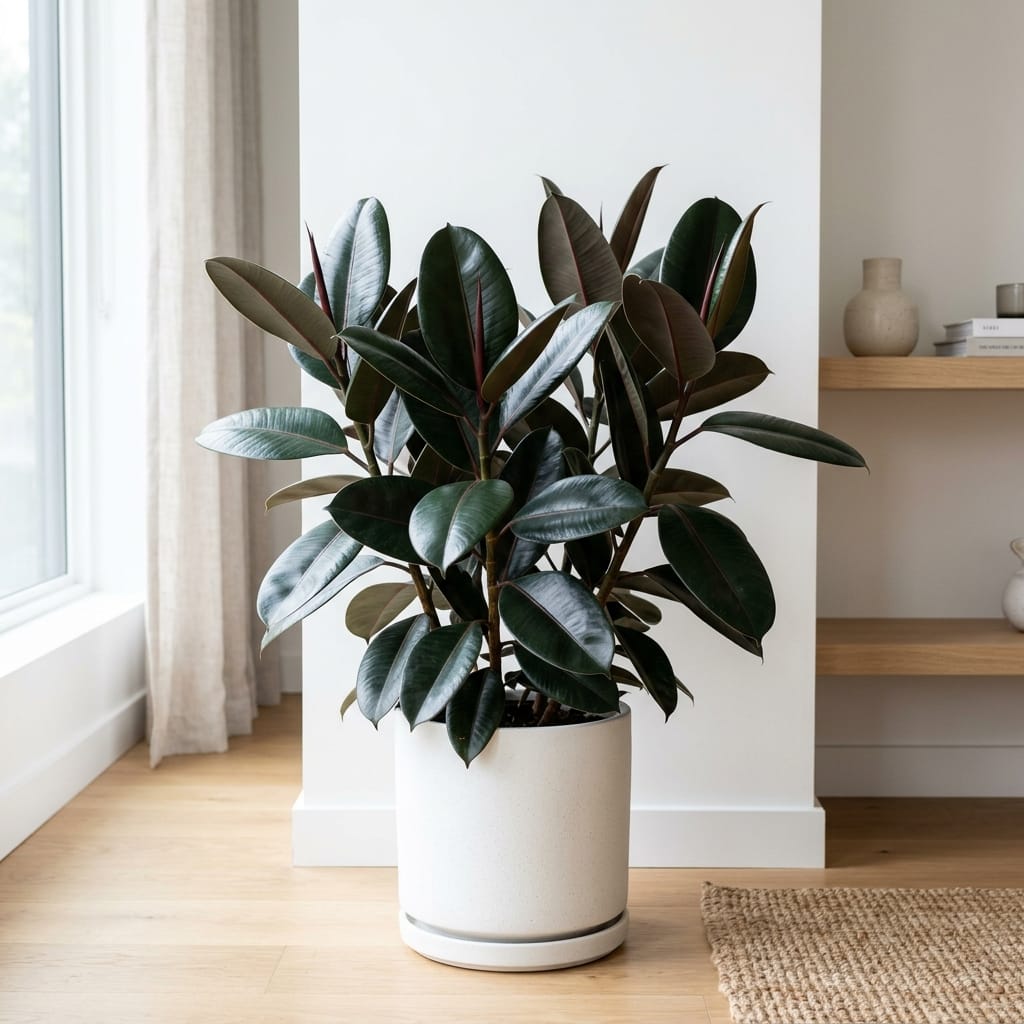
If you want a statement plant that looks expensive, grows impressively tall, and doesn’t demand constant attention — the rubber plant (Ficus elastica) is your answer. Those thick, glossy, almost leathery leaves come in everything from deep forest green to striking burgundy to creamy pink-and-green variegation.
I bought my first rubber plant as a 12-inch nursery pot. Four years later, it’s nearly 5 feet tall and one of the most-complimented plants in my home. Here’s how to grow yours into a showpiece.
Light
Rubber plants are in the Ficus family (yes, they’re related to the fiddle leaf fig), but they’re significantly more tolerant of imperfect conditions.
| Light Level | Result |
|---|---|
| Bright indirect | Best growth, vivid color in variegated types |
| Medium indirect | Good growth for green varieties |
| Low-medium | Slow growth, green varieties only. Variegated types lose coloring |
| Direct sun | A few hours of morning sun is fine; avoid intense afternoon sun |
Key point for variegated varieties: ‘Ruby’ and ‘Tineke’ rubber plants need brighter light to maintain their pink/cream coloring. In low light, they’ll revert to solid green. If your variegated rubber plant is losing its colors, it needs more light — consider a grow light.
Watering
Rubber plants store water in their thick leaves, making them moderately drought-tolerant.
My watering approach:
- Check the top 2 inches of soil
- If dry: water thoroughly, letting excess drain
- If still moist: wait a few more days
| Season | Frequency |
|---|---|
| Spring/Summer | Every 7-10 days |
| Fall/Winter | Every 14-21 days |
Overwatering signs: Yellowing lower leaves, mushy stems, leaf drop Underwatering signs: Drooping leaves, dry/crispy leaf edges, curling
The most common mistake is overwatering. When in doubt, wait another day. See our complete guide to watering mistakes to avoid.
Humidity
Rubber plants aren’t as humidity-demanding as some tropicals, but they appreciate it:
- Ideal: 40-60% relative humidity
- Acceptable: Average home humidity (30-40%)
- Signs of low humidity: Crispy leaf edges, dull-looking leaves
Boost humidity with a humidifier or by grouping plants together. In most homes, rubber plants do just fine without extra humidity measures.
Soil
Use a well-draining aroid-style mix:
- 2 parts potting soil
- 1 part perlite
- 1 part orchid bark
Good drainage is essential. Rubber plants will develop root rot quickly in waterlogged soil. Always use a pot with drainage holes.
For a deeper dive into potting mixes, check our soil mixing guide.
Repotting
Rubber plants are moderate growers and need repotting every 1-2 years.
- When: Spring (start of growing season)
- Size up: 2 inches larger in diameter
- Signs it’s time: Roots circling the pot, water runs straight through, stunted growth
Full instructions in our repotting guide.
Pruning and Shaping
This is where rubber plants really shine. Without pruning, they grow into tall, single-stem trees. With strategic pruning, you can create a gorgeous bushy, branching plant.
How to Prune
- Best time: Spring or early summer
- Cut above a node (where a leaf meets the stem) at a 45° angle
- Wear gloves — rubber plants bleed a sticky white latex sap
- The plant will produce 2-3 new branches from the cut point
Notching (for branches without pruning)
If you want branches lower on the trunk without cutting the top:
- Find a node where you want a branch
- Make a shallow diagonal cut about 1/3 through the trunk, just above the node
- The disrupted nutrient flow triggers a new branch at that point
- Seal the wound with cinnamon powder
The Sap
Rubber plant sap is sticky, white, and mildly irritating. Always:
- Wear gloves when pruning
- Protect flooring/furniture
- Wipe sap off leaves with a damp cloth
Cleaning the Leaves
Those big, beautiful leaves are dust magnets. Dusty leaves can’t photosynthesize efficiently, which slows growth.
Cleaning method:
- Mix a few drops of dish soap in water
- Wipe each leaf with a soft damp cloth
- Support the leaf from underneath while wiping
- Do this monthly
For more tips, read how to clean indoor plant leaves.
Fertilizing
- When: Spring through fall
- Frequency: Monthly
- Type: Balanced liquid fertilizer at half strength
- Winter: No fertilizer
Varieties
| Variety | Leaves | Notes |
|---|---|---|
| ‘Robusta’ | Deep green, large | Classic, most hardy |
| ‘Burgundy’ | Dark burgundy-black | Dramatic, almost black leaves |
| ‘Tineke’ | Cream, green, and pink | Needs bright light for color |
| ‘Ruby’ | Pink, cream, and green | Most colorful, needs bright light |
| ‘Shivereana’ | Mottled green and cream | Unique camouflage pattern |
Common Problems
Yellowing Lower Leaves
- Occasional lower leaf yellowing is normal — the plant sheds old leaves
- Widespread yellowing = overwatering. Reduce frequency and check drainage.
- See yellow leaves guide for detailed help
Leggy, Bare Trunk
- Caused by insufficient light
- Prune the top to encourage branching
- Move to a brighter spot
Leaf Drop
- Usually overwatering, cold drafts, or being recently moved
- Check soil moisture and stabilize the environment
- Rubber plants, like their fiddle leaf fig cousins, don’t love change
Pests
Rubber plants can attract mealybugs, scale, and spider mites. Wipe leaves regularly and inspect the undersides. For treatment options, see our pest control guide.
Toxicity
Rubber plants are mildly toxic to cats, dogs, and children. The latex sap can cause skin irritation and digestive upset if ingested. Keep out of reach of pets, or choose a pet-safe alternative.
Where to Buy
🌿 Get a Rubber Plant on AmazonFinal Thoughts
Rubber plants are one of the best “statement plants” you can own. They’re significantly hardier than their fiddle leaf fig relatives, grow impressively tall, and those thick glossy leaves are endlessly photogenic. With a little pruning knowledge, you can shape them into exactly the plant you want.
Start with a solid green ‘Robusta’ or ‘Burgundy’ if you’re new to ficus care, then graduate to the stunning variegated varieties once you’re confident.
More beginner-friendly picks in our easiest indoor plants guide.