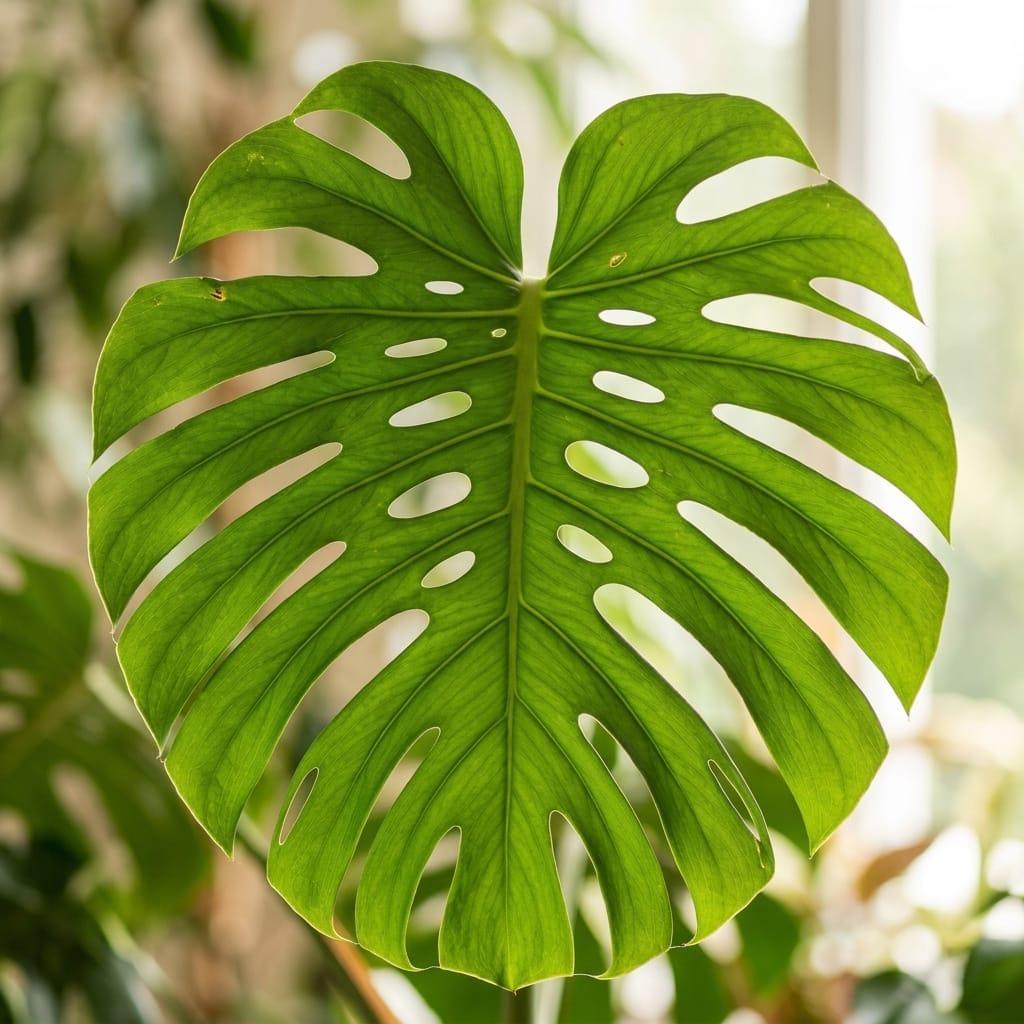
You bought a monstera expecting those dramatic swiss cheese leaves with all the holes and splits — and instead you’ve got a plant with boring, solid, heart-shaped leaves that look nothing like the photos on Instagram.
I’ve been there. My monstera produced about a dozen solid leaves before the first split appeared, and it was incredibly anticlimactic — just a tiny notch on one side. But once I figured out what the plant actually needed, the fenestrations came fast and dramatic.
Here are the 7 reasons your monstera isn’t splitting, ranked by how common they are.
First: Understanding Fenestrations
Quick science lesson. Those iconic holes and splits are called fenestrations (from the Latin fenestra, meaning window). Scientists believe they evolved for a few reasons:
- Better light capture: Gaps let light filter to lower leaves
- Wind resistance: Holes reduce wind stress on large leaves
- Rain distribution: Water flows through to the roots below
Fenestrations develop as the plant matures and in response to growing conditions. Specifically: light, support, and overall plant health. A young monstera in a dark corner will never develop them. An older monstera in bright light with a moss pole will go crazy with them.
Key fact: Once a leaf unfurls, its shape is permanent. That solid leaf won’t suddenly develop holes. But the next leaf the plant produces will reflect current conditions.
Reason 1: Your Plant Is Too Young
The most common reason — and the simplest.
Young monsteras (under 2-3 years old or with fewer than 8-10 leaves) produce solid leaves. This is completely normal development. The plant needs to establish a strong root system before investing energy in complex leaf shapes.
Fix: Patience. Give it good care and time. Most monsteras start fenestrating after producing 8-12 leaves.
Reason 2: Not Enough Light
The #1 fixable cause of no fenestrations.
In the wild, monsteras climb tall trees to reach brighter light at the canopy. Fenestrations are actually a response to light — more light = more splits. A monstera in a dim corner will produce small, solid leaves because there’s no evolutionary reason to fenestrate in low light.
Fix:
- Move to within 3-5 feet of a bright window (east, north, or filtered south)
- 6-8 hours of bright indirect light is ideal
- Avoid direct afternoon sun (burns leaves)
- Consider a grow light if your space is naturally dark
Reason 3: No Support to Climb
Hugely underrated factor.
Monsteras are natural climbers. When they climb (using aerial roots to attach to surfaces), they produce significantly larger, more fenestrated leaves. When they sprawl on the ground, leaves stay smaller and simpler.
A moss pole or trellis triggers the plant’s “climbing mode,” telling it to produce bigger, more complex leaves.
Fix: Add a moss pole or sturdy trellis and tie the main stem to it with soft plant ties. Within a few growth cycles, new leaves will be noticeably larger and more split.
Reason 4: Root-Bound or Poor Soil
If your monstera is severely root-bound, it can’t absorb enough nutrients and water to support complex leaf development. Similarly, depleted or compacted soil provides poor nutrition.
Fix:
- Repot into a pot 1-2 inches larger
- Use well-draining aroid soil mix (potting soil + perlite + orchid bark)
- Repot in spring for best results
Reason 5: Under-Fertilizing
Fenestrated leaves require more energy (and nutrients) to produce than simple leaves. A nutrient-starved monstera will default to simpler, smaller leaves to conserve resources.
Fix:
- Fertilize monthly during the growing season (spring/summer) with a balanced liquid fertilizer diluted to half strength
- Stop fertilizing in fall/winter
- See our fertilizer guide for product picks
Reason 6: Low Humidity
While not the primary driver, low humidity can stress a monstera enough to affect leaf development. Monsteras prefer 50-60% humidity.
Fix:
- Use a humidifier during winter when home humidity drops
- Group plants together for a microclimate
- See do plants need humidity?
Reason 7: Inconsistent Care
Monsteras produce their best leaves when conditions are stable. Constantly moving the plant, erratic watering, or temperature swings can stress it into producing simpler leaves.
Fix: Pick a good bright spot and leave the plant there. Develop a consistent watering routine. Stable = happy = fenestrated.
The Fenestration Action Plan
If you want to maximize fenestrations, do ALL of these:
| Action | Impact | Timeline |
|---|---|---|
| Move to bright indirect light | ⭐⭐⭐⭐⭐ | See results in 2-3 new leaves |
| Add a moss pole | ⭐⭐⭐⭐ | Results once plant attaches |
| Repot if root-bound | ⭐⭐⭐ | Results in next growing season |
| Fertilize monthly (spring/summer) | ⭐⭐⭐ | Gradual improvement |
| Increase humidity to 50-60% | ⭐⭐ | Supportive improvement |
| Be patient (age-related) | ⭐⭐⭐⭐⭐ | 2-3 years for young plants |
What to Expect
After improving conditions, here’s a realistic timeline:
- Month 1-2: Next leaf may be slightly larger but possibly still solid
- Month 2-4: New leaves should start showing small splits/notches
- Month 4-8: Progressively more fenestrations on each new leaf
- Year 2+: Full, dramatic fenestrations with both holes and splits
The key is understanding that each new leaf reflects current conditions at the time it’s developing, not past conditions. So improvements compound over time.
For complete monstera care, read our monstera care guide.
FAQs
At what age do monsteras start splitting? Most begin at 2-3 years old, after producing 8-12 leaves. Very young monsteras always produce solid leaves.
Will small monstera leaves ever split? No — once a leaf unfurls, its shape is permanent. Improve conditions for the NEXT leaves.
Does a moss pole help? Yes! Climbing monsteras consistently produce larger, more fenestrated leaves.
Can too much light cause no splits? The opposite — too LITTLE light is the most common cause. Bright indirect light is essential.
How long until I see fenestrations? Typically 2-4 months after improving conditions. You should see changes within 2-3 new leaves.
Happy growing! 🌿