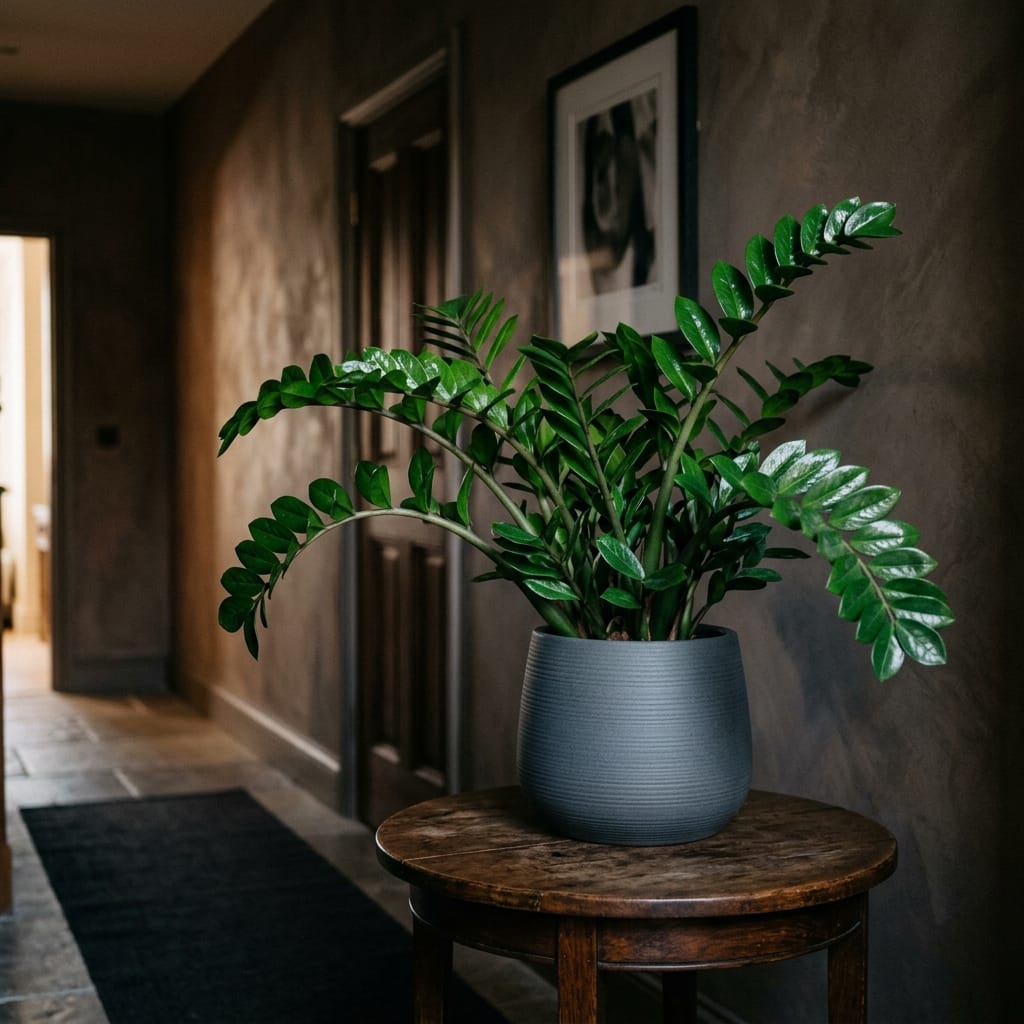
I have a ZZ plant tucked into the darkest corner of my hallway — a spot where literally nothing else would survive. No direct sunlight, minimal ambient light, and I honestly forget it exists for weeks at a time. And somehow it looks better than the day I bought it.
That’s the magic of ZZ plants (Zamioculcas zamiifolia). They’re not just low-maintenance — they’re practically no-maintenance. Native to drought-prone regions of Eastern Africa, they evolved to survive extended dry periods by storing water in thick underground rhizomes. This makes them one of the most forgiving houseplants you can own.
But there’s a difference between a ZZ plant that’s surviving and one that’s thriving. Here’s everything you need to know.
Popular ZZ Plant Varieties
Standard Green ZZ
The original. Glossy, dark green leaves on upright stems that arch gracefully. Each stem has 6-8 pairs of leaves arranged in a feather-like pattern. Grows 2-3 feet tall and wide.
Raven ZZ (Zamioculcas zamiifolia ‘Dowon’)
The showstopper. New leaves emerge bright lime green and gradually darken to near-black over several weeks. The contrast of new and mature leaves on the same plant is stunning. Same bulletproof care as the standard variety.
Zenzi ZZ (Dwarf ZZ)
A compact variety with shorter, more tightly clustered leaves. Perfect for smaller spaces, desks, or shelves where a full-size ZZ would be too large. Maxes out around 12-18 inches.
Zamicro ZZ
Even smaller than Zenzi, with tiny, rounded leaves. Very rare and harder to find, but adorable for tiny plant collections.
Light Requirements
ZZ plants are the undisputed champions of low light. Here’s the spectrum:
- Very low light: They’ll survive in a windowless office with only fluorescent lighting. Growth will be minimal, but the plant won’t die.
- Low to medium indirect light: The practical sweet spot. A north-facing window or a spot several feet from any window works great.
- Bright indirect light: If you actually want your ZZ to grow noticeably, this is where it performs best. You might get 2-3 new stems per year instead of 1.
- Direct sunlight: Avoid this. ZZ plant leaves burn easily in direct sun, developing brown or bleached patches.
The key difference from snake plants: While snake plants can handle some direct sun, ZZ plants cannot. Keep them out of direct rays.
Watering: Less is More (Seriously)
If there’s one thing to remember about ZZ plants, it’s this: you are almost certainly overwatering it.
Why ZZ Plants Need So Little Water
Underground, your ZZ plant has thick, potato-like structures called rhizomes. These are essentially water storage tanks. When you water, the rhizomes soak up and store moisture for weeks. This is why they’re so drought-tolerant — they carry their own water supply.
The Simple Rule
Let the soil dry out completely between waterings. And I mean completely — not just the top inch. The entire pot should be dry before you water again.
Seasonal Schedule
| Season | Frequency | Notes |
|---|---|---|
| Spring/Summer | Every 3-4 weeks | Growing season, slightly more water |
| Fall | Every 4-5 weeks | Growth slowing |
| Winter | Every 5-6 weeks | Near-dormant, barely water |
For a deep dive on ZZ plant watering, check out our dedicated ZZ plant watering guide.
Warning Signs
- Yellow leaves = overwatering (the #1 problem)
- Mushy stems at the base = severe overwatering / root rot
- Wrinkled or shriveled stems = underwatering (rare, but it happens)
Soil, Pots, and Repotting
Soil
ZZ plants need well-draining soil. A cactus/succulent mix works perfectly, or mix standard potting soil with perlite (50/50). The goal is soil that doesn’t stay soggy.
Pots
- Always use pots with drainage holes. No exceptions.
- Terracotta pots are great because they wick excess moisture.
- ZZ plants don’t mind being slightly root-bound, so don’t rush to upsize.
When to Repot
- Every 2-3 years, or when the rhizomes start pushing against the pot walls
- You’ll sometimes see rhizomes literally cracking plastic pots — that’s when it’s time
- Go up only one pot size
- Spring is ideal for repotting
For step-by-step instructions, see our repotting guide.
🌱 Get Well-Draining Potting MixPropagation
ZZ plants can be propagated, but patience is essential — this is a slow grower at every stage.
Method 1: Division (Fastest)
During repotting, separate the rhizomes:
- Remove the plant from its pot
- Gently pull apart or cut rhizome clusters, ensuring each section has stems and roots
- Plant each division in its own pot
- Water lightly and place in indirect light
This is the fastest method because each division already has established roots and rhizomes.
Method 2: Stem Cuttings
- Cut a healthy stem at the base
- Place the cut end in water (1-2 inches deep)
- Change water weekly
- Wait 2-4 months for roots and a small rhizome to form
- Plant in soil once the rhizome is marble-sized
Method 3: Individual Leaf Cuttings
- Pluck individual leaves from a stem
- Let the cut end callous for a few hours
- Stick the cut end into moist soil or perlite
- Mist occasionally to keep soil barely moist
- Wait 3-6 months — yes, really
Be patient: ZZ propagation is a long game. Individual leaves can take 6+ months to develop a rhizome and push out new growth. But it works, and it’s satisfying to grow a new plant from a single leaf.
Common Problems and Fixes
| Problem | Likely Cause | Fix |
|---|---|---|
| Yellow leaves | Overwatering | Let soil dry completely, reduce watering |
| Mushy stems at base | Root/rhizome rot | Unpot, remove rot, repot in dry soil |
| Stems leaning/falling | Too little light or top-heavy | Rotate plant, move to brighter spot |
| No new growth | Normal (slow grower) or dormancy | Patience; fertilize lightly in spring |
| Brown leaf tips | Dry air, salt buildup, or sunburn | Flush soil, move from direct light |
| Leaves dropping | Cold drafts or overwatering | Move away from drafts, check watering |
| Leggy, stretched growth | Reaching for light | Move to a brighter location |
For a comprehensive look at yellow leaf issues across all plants, check our yellow leaves troubleshooting guide.
ZZ Plant Myths: Debunked
“ZZ plants are extremely poisonous”
Partially true, but overblown. Yes, ZZ plants contain calcium oxalate crystals, which can irritate skin and cause stomach upset if ingested. But they’re not deadly — they’re about as toxic as a philodendron or dieffenbachia. The internet rumor that they “cause cancer” is completely false. Just don’t eat them and wash your hands after handling, especially if you have sensitive skin.
“ZZ plants don’t need ANY light”
False. They need some light to photosynthesize. They can survive in very low light longer than almost any other plant, but truly zero light will slowly kill them. A windowless room with a lamp that’s on regularly is the minimum.
“ZZ plants never need water”
False. They’re drought-tolerant, not drought-proof. If you forget for 2-3 months, you might see shriveled stems and leaf drop. Once a month is a safe minimum.
Product Recommendations
1. Costa Farms ZZ Plant
A lush, glossy ZZ plant shipped ready to thrive. Great starting size and comes in a grower’s pot.
🌿 Get Your ZZ Plant on Amazon2. Raven ZZ Plant
The dramatic near-black variety. If you want something unique and eye-catching, this is it.
🖤 Get a Raven ZZ Plant3. Well-Draining Soil Mix
Cactus/succulent mix that provides the fast drainage ZZ plants need.
🌱 Get the Right Soil MixNot sure whether a ZZ or snake plant is right for you? Read our detailed snake plant vs. ZZ plant comparison — or get both!
FAQs
How often should I water my ZZ plant? Every 3-4 weeks in spring/summer, and every 5-6 weeks in winter. Always let the soil dry completely. See our full watering guide.
Can ZZ plants grow in no light? They can survive in very low light, even fluorescent-only offices. But they do need some light source for photosynthesis.
Are ZZ plants toxic? Yes, mildly toxic if ingested and sap can irritate skin. Not as dangerous as internet rumors suggest. For pet-safe options, see our pet-safe plants guide.
Why are my ZZ plant leaves turning yellow? Almost always overwatering. Let the soil dry completely and reduce watering frequency.
How do I propagate a ZZ plant? Division is fastest. Leaf and stem cuttings work but take 3-6 months to develop rhizomes. Patience is key.
How fast do ZZ plants grow? Slow — expect 1-3 new stems per year. New stems emerge and grow to full height quickly, but new stems appear infrequently.
What is a Raven ZZ plant? A variety with near-black foliage. New leaves start green and darken over weeks. Same easy care as standard ZZ.
Happy growing! 🌿