Introduction
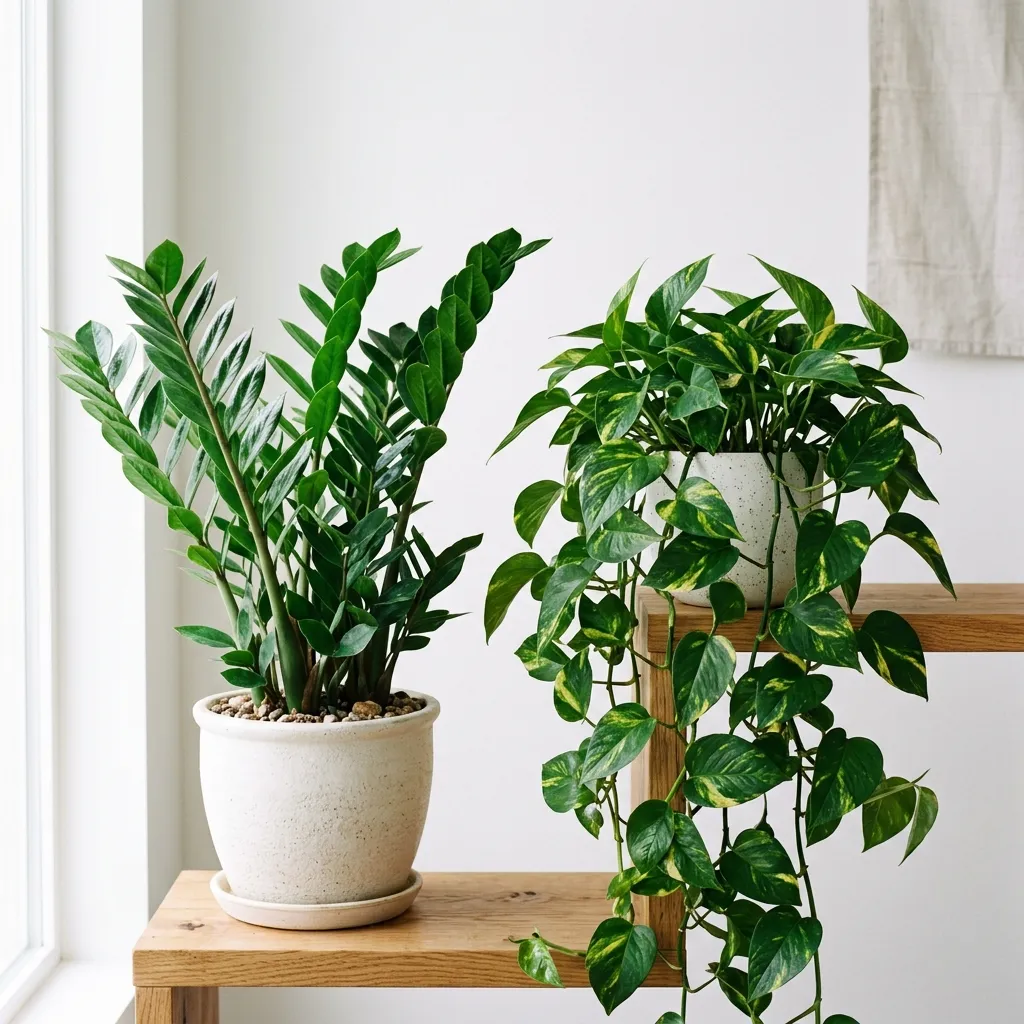
The ZZ plant and pothos are two of the most recommended houseplants on the planet, and for the same reason: they’re absurdly hard to kill. If you’ve ever searched “easy indoor plants” or “plants for beginners,” both of these have shown up in every list you’ve read. But here’s what those lists don’t always make clear — despite both being low-maintenance champions, ZZ plant and pothos are completely different in how they grow, how they look, and how they fill a space.
I got my first ZZ plant about four years ago, a few months after my pothos was already trailing happily across my kitchen cabinets. I remember being surprised by how different it felt. The pothos was all motion — constantly pushing out new leaves, unfurling vines, reaching toward the light. The ZZ plant just… sat there. Stoically. Glossy and gorgeous, but in no rush to do anything. It took me a while to appreciate that energy, but now I consider both essential to my collection.
In this comparison, I’ll walk through every meaningful difference between ZZ plant and pothos — growth habits, watering, light tolerance, propagation, display options, and cost — so you can decide which one (or both) deserves a spot in your home.
Quick Comparison Table
| Feature | ZZ Plant | Pothos |
|---|---|---|
| Difficulty | ⭐ Ultra-easy | ⭐ Ultra-easy |
| Growth Habit | Upright, arching stems | Trailing/climbing vine |
| Mature Size | 2-3 feet tall and wide | Vines 6-10+ feet long |
| Light Needs | Very low to bright indirect | Low to bright indirect |
| Watering | Every 2-4 weeks | Every 7-14 days |
| Growth Speed | Slow | Fast |
| Propagation | Very slow (months) | Very fast (1-2 weeks) |
| Humidity | Not picky | Not picky |
| Toxicity | Toxic to pets and humans | Toxic to pets and humans |
| Average Price | $15-30 | $5-15 |
Appearance and Growth Habits
This is where the difference between these two plants is most striking.
ZZ Plant: The Quiet Showstopper
The ZZ plant (Zamioculcas zamiifolia) grows as a series of upright, gently arching stems lined with paired, glossy dark green leaves. Each stem emerges from a thick underground rhizome — essentially a storage bulb that holds water and nutrients. The overall look is architectural and polished, almost like the plant was designed by a furniture company.
ZZ plants grow slowly and stay relatively compact. A mature specimen might reach 2-3 feet tall and wide over several years. New stems emerge as tightly rolled shoots from the base of the plant, gradually unfurling to reveal that signature row of paired leaves. The Raven ZZ variety, with its almost-black leaves, has become especially popular for modern and minimalist interiors.
For a complete care breakdown, check out my ZZ plant care guide.
Pothos: The Enthusiastic Vine
Pothos (Epipremnum aureum) couldn’t be more different. Instead of upright stems, pothos sends out long, flexible vines covered in heart-shaped leaves. Left unpruned, a single vine can grow 10 feet or more indoors. The plant naturally trails downward, making it ideal for hanging baskets, high shelves, and macramé hangers. Alternatively, give it a moss pole or trellis and it’ll climb upward.
Golden Pothos — with green and golden-yellow variegated leaves — is the variety you’ll encounter most often, but Marble Queen, Neon, and Jade are all beautiful options. Growth is fast and visible, which is part of what makes pothos so satisfying to grow. You can read everything about caring for this vine in my pothos care guide.
Visual Contrast
I think of these two plants as design complements:
- ZZ plant = structure, form, and stillness
- Pothos = flow, movement, and lush abundance
In my living room, my ZZ plant sits on a low side table where its arching stems create a clean silhouette against the wall. My pothos trails from a high shelf on the opposite side of the room, its vines draping down like green curtains. The contrast is what makes the arrangement work.
Watering: Opposite Ends of Easy
Both plants are drought-tolerant, but the ZZ plant takes it to another level.
ZZ Plant: Water It and Forget It
Thanks to those thick underground rhizomes, ZZ plants store water like mini reservoirs. This means you can water your ZZ plant every 2-4 weeks — and in winter, I’ve stretched mine to every 5-6 weeks without issue. Overwatering is the only real way to harm a ZZ plant; the rhizomes and roots will rot if the soil stays consistently wet.
I use a well-draining potting mix and always make sure the pot has a drainage hole. For a deeper dive on getting the watering right, I wrote a full guide on how to water ZZ plant.
Pothos: Thirstier, But Still Easy
Pothos prefers more frequent watering — roughly every 7-14 days, depending on light and temperature. It’s still drought-tolerant compared to most houseplants, but it doesn’t have those built-in water storage rhizomes. When a pothos gets too dry, the leaves will droop and curl. The silver lining is that pothos tells you exactly when it needs water, and it recovers quickly once you provide it.
Practical Takeaway
If you travel often, work long hours, or simply forget to water plants, ZZ plant is the more forgiving choice. If you don’t mind a weekly watering routine, pothos is just as easy. Either way, a moisture meter takes the guesswork out of both.
Light Tolerance
Both of these plants are famous for tolerating low light, and that reputation is well-deserved — but there are nuances.
ZZ plant is one of the most shade-tolerant houseplants available. It can survive in a room with no natural light, growing (slowly) under just fluorescent or ambient lighting. In my office, I had a ZZ plant on a shelf far from any window for two years, and it was perfectly fine — just slower growing. It also handles bright indirect light well, which speeds up growth.
Pothos also tolerates low light but responds to it more visibly. In dim conditions, pothos vines stretch toward any available light source, producing smaller, more widely-spaced leaves. Variegated varieties like Golden and Marble Queen will lose much of their variegation, reverting to solid green to maximize chlorophyll production. Pothos looks its best in medium to bright indirect light.
If your space is genuinely dark — a windowless bathroom, an interior hallway, a basement — ZZ plant has the edge. Both plants are featured in my roundup of the easiest indoor plants for beginners specifically because of this adaptability.
Propagation Speed
This is one of the starkest differences between these two plants.
Pothos Propagation: Instant Gratification
Pothos might be the most satisfying plant to propagate. Cut a stem below a node, place it in water, and you’ll typically see roots emerging within 7-14 days. A few weeks after that, you can transfer the cutting to soil and watch it take off. I’ve filled entire pots with pothos cuttings from a single mother plant in a single growing season. For the full step-by-step, check out my guide on how to propagate pothos.
ZZ Plant Propagation: A Test of Patience
ZZ plant propagation works, but it requires genuine patience. The most common method is leaf cuttings — you snip individual leaves (or leaflets), stick them in soil, and wait. And wait. ZZ leaf cuttings need 2-4 months just to develop a small rhizome underground, and it can be 6-12 months before you see a new stem emerge above the soil.
Division is faster — if your ZZ plant has multiple clumps, you can separate them during repotting — but you need a mature, well-established plant with multiple rhizomes to divide in the first place.
The Verdict on Propagation
If you enjoy propagating plants and sharing cuttings with friends, pothos is in a league of its own. ZZ plant propagation is possible but requires the kind of patience most of us don’t naturally have.
Display Options
How you display a plant matters as much as how you care for it, and these two offer very different styling possibilities.
ZZ Plant Display Ideas
- Tabletop accent — small to medium ZZ plants fit perfectly on coffee tables, side tables, and desks
- Floor plant — a mature ZZ in a statement pot anchors a room corner beautifully
- Grouped arrangements — pairs well with other upright plants like snake plants for a sculptural display
- Offices and reception areas — the polished, professional look suits workspaces
Pothos Display Ideas
- Trailing from shelves — the classic pothos look, vines cascading downward
- Hanging baskets — shows off the trailing habit at eye level
- Trained on walls — use small adhesive hooks to guide vines along a wall or ceiling
- Climbing a moss pole — encourages larger leaf growth and a more compact shape
- Bathroom greenery — thrives in the humidity and looks lush
Space Efficiency
Both plants are space-efficient but in different ways. ZZ plant takes up a defined footprint on a table or floor — it doesn’t spread beyond its pot. Pothos takes up very little surface area at its base but extends vertically or horizontally through its vines, filling space you might not otherwise use.
Cost and Availability
ZZ plant typically costs $15-30 for a standard green variety. Raven ZZ and other specialty varieties can run $25-40+. ZZ plants are widely available at garden centers and big-box stores, though selection of uncommon varieties can be limited locally.
Pothos is the budget king of houseplants. A 6-inch Golden Pothos usually costs $5-15, and even premium varieties like Marble Queen are typically under $20. You can find pothos at virtually every store that sells plants, including grocery stores, hardware stores, and gas stations (I’m not joking — I’ve seen them at gas stations).
🌿 Get a Costa Farms ZZ Plant — Glossy, Low-Maintenance, and Beautiful 🌿 Shop Golden Pothos — The Best-Selling Houseplant for a ReasonWhich Should You Choose?
After years with both, here’s how I think about it:
Choose a ZZ plant if you:
- Want a polished, architectural look
- Have very low light or a windowless room
- Forget to water plants for weeks at a time
- Prefer slow, contained growth that doesn’t need pruning
- Want a desktop or tabletop plant that stays put
Choose pothos if you:
- Love visible, fast growth
- Want a trailing plant for shelves, walls, or hanging baskets
- Enjoy propagating and sharing plants with friends
- Want the cheapest entry point into houseplants
- Have vertical or overhead space to fill
Choose both if you:
- Want visual variety without adding care complexity
- Have different spots in your home that need different plant shapes
- Appreciate the contrast between stillness and movement in your decor
Honestly, my recommendation for most people is to just get both. Together they cover almost every display style, light condition, and aesthetic preference — and combined, they’ll cost you under $30. That’s the best deal in indoor gardening.
FAQs
Q: Is a ZZ plant or pothos easier to care for? A: Both are among the easiest houseplants you can own. ZZ plant is slightly more drought-tolerant thanks to its rhizomes, but pothos is more forgiving of varying light conditions and bounces back faster from neglect. It’s essentially a tie.
Q: Can ZZ plants and pothos grow in low light? A: Yes, both tolerate low light remarkably well. ZZ plant is especially well-suited to dim rooms, hallways, and offices with no windows. Pothos will survive in low light but may lose variegation and grow more slowly.
Q: Which grows faster, ZZ plant or pothos? A: Pothos grows much faster. A healthy pothos can add several feet of vine per year, while ZZ plants typically produce only a few new stems annually. If you want fast results, pothos is the clear choice.
Q: Are ZZ plants and pothos toxic to pets? A: Yes, both are toxic to cats and dogs. ZZ plant contains calcium oxalate crystals throughout the entire plant, and pothos contains them primarily in its leaves and stems. Keep both out of reach of curious pets.
Q: Can I propagate ZZ plant as easily as pothos? A: No. Pothos propagation is fast and nearly foolproof — cuttings root in water within 1-2 weeks. ZZ plant propagation through leaf cuttings is possible but takes 2-6 months to produce new rhizomes and growth. Division of an existing plant is faster but requires a mature specimen.
Q: Which plant is better for a desk or office? A: Both are excellent office plants. A small ZZ plant works well on a desk since it stays compact and upright. Pothos is great for a desk edge where it can trail, or on a filing cabinet. If your office has no windows, ZZ plant has a slight edge for tolerating very low light.
Happy growing! 🌿